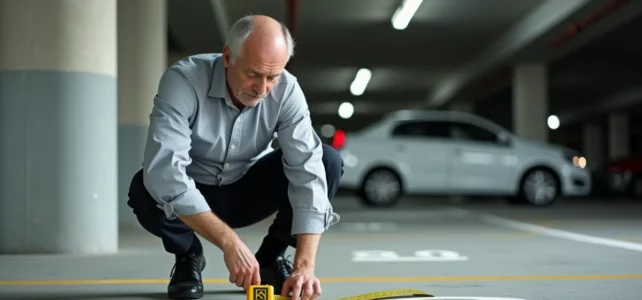
A parking space in a condominium is not just a rectangle marked on the ground. Its compliance depends on three distinct elements: its physical dimensions, its legal status in the descriptive state of division, and adherence to regulatory obligations regarding accessibility or charging infrastructure. Neglecting any of these aspects exposes the co-owner to disputes, or even the unenforceability of their right to use it.
Numbering and descriptive state of division: the forgotten compliance point
Most co-owners check the size of their space. Few think to verify the consistency between the ground markings and the descriptive state of division. This document, attached to the condominium regulations, assigns a lot number to each individual space.
When the painted numbering on the ground does not match that recorded in the descriptive state, the marking loses its enforceable character. A co-owner who parks in space 14 while their lot designates number 12 legally occupies a space that does not belong to them, even if no one has complained for years.
In practice, it is necessary to compare three documents: the descriptive state of division (available from the property manager or the land registry service), the parking plan attached to the regulations, and the physical ground markings. Any discrepancies should be reported at the general assembly for a vote on an update. To better understand the rules of the parking space usage, this verification is the first concrete step even before taking out a measuring tape.
Legal status of the space: private lot, private enjoyment, or common area
Three regimes coexist in French condominiums, and each determines what the co-owner can do with their space.
- Private lot: the space is listed as a distinct lot in the descriptive state of division, with its own share of charges. The co-owner can sell it, rent it, or make certain modifications without selling their apartment.
- Right of private enjoyment: the space remains legally a common area, but its exclusive use is granted to a co-owner by the regulations. It cannot be sold separately from the main lot to which it is attached.
- Common area without allocation: parking is open to all residents according to the terms defined by the general assembly. No co-owner can claim a fixed space.
Confusing private enjoyment with a private lot is the most common mistake. A co-owner who attempts to rent a space to an outside party, of which they only have the right of private enjoyment, acts without legal basis, as the property does not belong to them. The condominium regulations and the descriptive state of division resolve this issue, not habit or length of occupancy.
Dimensions and NF P 91-120 standard: what the ground markings must comply with
The NF P 91-120 standard sets the reference dimensions for parking spaces. For a perpendicular parking space (facing the traffic lane), the standard specifies a minimum length and sufficient width to allow the opening of doors without encroaching on the neighboring space.
These dimensions apply to new constructions. In older condominiums, spaces are sometimes narrower. A space that does not comply with the standard does not become illegal as a result, but it may pose problems during a sale or a dispute between co-owners regarding the actual use of the space.
The ground markings themselves have a legal function: they materialize the boundaries of the lot or the right of enjoyment. Faded or approximate markings weaken the proof of the extent of the space. The property manager is responsible for maintaining this marking legible, and any co-owner can request its restoration at the general assembly.

PMR obligations and right to install a charging point
Two distinct regulations supplement the dimensions and legal status, and they concern the condominium as a whole.
Spaces accessible to people with reduced mobility
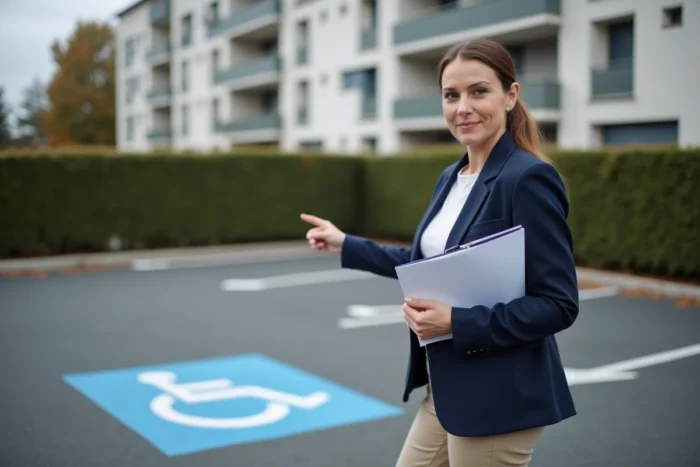
Parking lots in new condominiums must include a percentage of spaces adapted for people with reduced mobility. These spaces are wider to allow transfer from a wheelchair, and their vertical and ground signage is mandatory. In existing condominiums, the absence of PMR spaces does not constitute an infringement, but any renovation of the parking lot may trigger the obligation for compliance according to the decree of April 20, 2017.
Right to install a charging point in the condominium
Any co-owner or tenant with a parking space can have a charging point for electric vehicles installed at their own expense. This right, governed by the LOM law, requires the property manager not to oppose the request unless there is a serious and legitimate reason. The refusal must be justified and can be contested in court.
Thus, the compliance of a space is not limited to its dimensions. A condominium parking lot that does not allow the passage of cables to the spaces, or whose electrical panel cannot support any extension, poses an infrastructure problem that falls under collective responsibility.
Practical verification: the documents to cross-check before acting
To establish the complete compliance of a space, four documents are sufficient:
- The condominium regulations, which specify the nature of each space (private, private enjoyment, common area)
- The descriptive state of division, which assigns a lot number and shares to each individual space
- The parking plan attached to the regulations, to be compared with the current physical markings
- The recent general assembly minutes, to check if any modifications to signage or allocation have been voted on
Any inconsistency between these documents and the reality on the ground justifies an item on the agenda of the next assembly. The property manager is required to provide these documents upon request, and the council of co-owners can assist in the verification process.
The compliance of a parking space in a condominium relies on the alignment between the law (descriptive state, regulations), the physical (markings, dimensions, PMR signage), and the infrastructure (pre-electrical equipment). Correcting just one of these aspects without checking the others leaves a risk that the next buyer or the next neighborhood conflict will not fail to reveal.