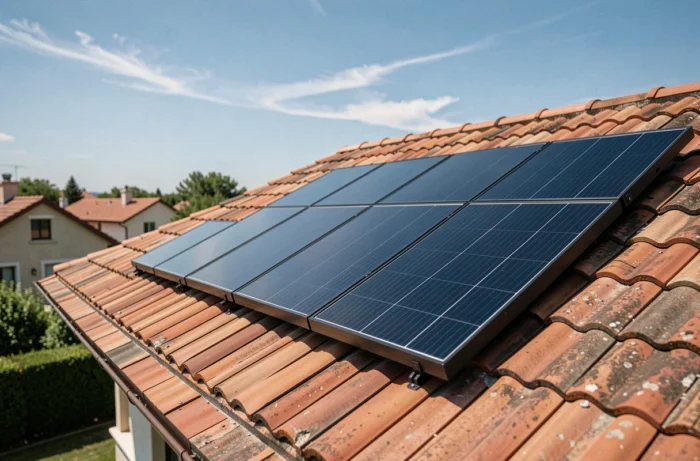
Comparing hot water production systems involves measuring three variables: the cost of consumed energy, the share of needs covered, and the lifespan of the equipment. Solar thermal heating stands out on these three axes, but the actual differences depend on the region, sizing, and the current aid framework. Here’s what the available data says.
Solar coverage rate: what thermal collectors really cover
The solar water heater does not completely replace a conventional system. It reduces the energy load by providing a portion of the annual hot water needs, with the remainder being covered by a backup (electric, gas, or thermodynamic).
The coverage rate varies significantly depending on the geographical area, the orientation of the collectors, and the roof slope. Even in less sunny regions, solar thermal covers a significant share of hot water needs. The gap between the south and the north is real, but it does not disqualify low-sunshine regions: it modifies the payback time.
To better understand the advantages of solar thermal heating and the principle of the heat transfer fluid that carries heat from the collectors to the tank, the mechanism deserves to be detailed beyond just the coverage rate.
Installation cost and financial aid: a framework that changed in 2026
The price of an individual solar water heater varies according to the collector area, the tank volume, and the type of installation. Raw comparisons between quotes can be misleading if they ignore the recent regulatory context.

Since September 1, 2026, MaPrimeRénov’ “per gesture” no longer finances solar water heaters in mainland France, according to decree n° 2026-822 of August 25, 2026. This removal changes the profitability calculation for households that relied on this aid to reduce their out-of-pocket expenses.
Other schemes remain and can partially compensate for this loss:
- Energy savings certificates (CEE), including bonus premiums under certain conditions, remain available for solar thermal installations.
- The zero-interest eco-loan (éco-PTZ) allows financing the equipment without interest, subject to the housing’s eligibility.
- The reduced VAT rate applies to supply and installation in homes over two years old.
The enhanced CEE premium has a constraint that many households discover late. A household that retains a backup using a fossil fuel may be excluded from the bonus. In other words, coupling a solar water heater with an existing gas boiler does not guarantee access to the maximum premium. This criterion is included in the conditions of the CEE BAR-TH-143 sheet for combined solar systems.
Individual solar water heater or combined solar system: two different logics
The individual solar water heater (CESI) produces only domestic hot water. The combined solar system (SSC) also supplies central heating. The choice between the two is not just a budget question.
The SSC requires low-temperature emitters (underfloor heating, oversized radiators) to function properly. A home equipped with standard high-temperature radiators will not benefit from an SSC without additional work on the heating network. This constraint, mentioned in the CEE BAR-TH-143 sheet, is often underestimated during the initial quote.
The French market confirms this difference in maturity. In 2025, CESI installations moderately declined, while the decline of combined solar systems was much more pronounced. This dynamic suggests that the CESI remains the most accessible entry point for an individual.
Lifespan and maintenance of solar thermal panels
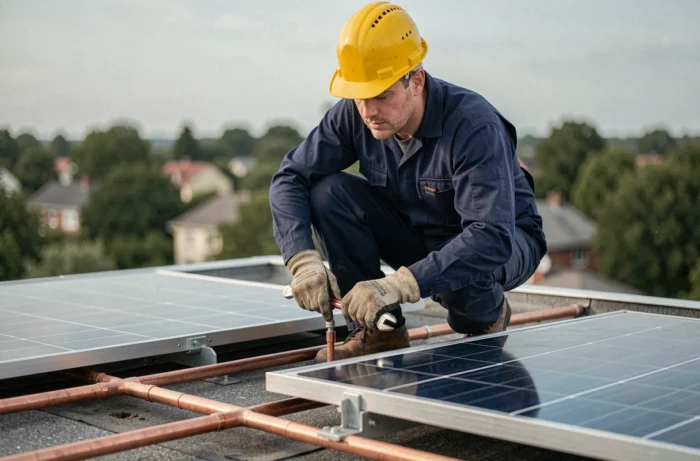
The longevity gap between installations depends on the quality of the equipment, exposure to the elements, and the frequency of checking the heat transfer fluid.
Routine maintenance remains limited: checking the circuit pressure, verifying the fluid condition, and visually inspecting the collectors. A malfunction of the circulator or a leak in the heat transfer fluid reduces efficiency without any visible signal on the bill for several months.
Carbon footprint and free energy: what solar thermal changes in daily life
The solar water heater does not emit CO2 during its operation. The energy captured by the panels is free and renewable. This free resource distinguishes solar thermal from systems that depend on the price of gas or electricity, two items whose rates have significantly increased in recent years.
Solar thermal does not eliminate dependence on the grid. Backup remains necessary in winter or during prolonged cloudy weather. But the share of substituted energy, even partial, results in a measurable reduction in the annual hot water bill.
A well-sized CESI in temperate zones covers the majority of summer needs without backup. In mid-seasons, solar takes care of a portion that avoids peak consumption during high-demand hours. This smoothing of energy demand benefits both the wallet and the electrical grid.
The profitability calculation today depends less on aids than on the price of avoided energy. With the end of MaPrimeRénov’ by gesture for this type of equipment, it is the cost differential between captured solar energy and purchased energy that determines the payback time. The higher the price of conventional kWh, the shorter this time becomes.


