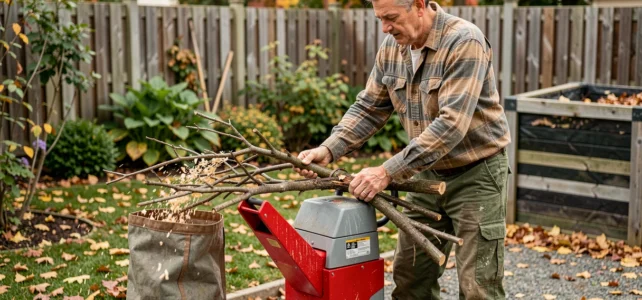
When you end up with a pile of hazel, thuja, and rose branches after a day of pruning, the question isn’t whether you need a shredder, but which one will produce a truly usable mulch. All shredders reduce the volume of green waste. Not all provide a usable result at the foot of flower beds or in the vegetable garden.
Particle size of the mulch: the criterion determined by the type of blades
An effective mulch requires chips that are neither too fine nor too coarse. If they are too fine, they compact and form an impermeable crust. If they are too coarse, they allow light to pass through, and weeds can easily break through.
The cutting system of the shredder directly affects this particle size. A blade disc shredder chops soft plant materials (leaves, green stems, small branches) into irregular, often fibrous fragments. The result is suitable for quick composting, but less so for a uniform mulch on a flower bed.
A rotor or turbine shredder crushes and cuts simultaneously. The resulting mulch is more uniform, with flattened pieces that interlock better with the soil. To produce quality plant mulch, this type of mechanism offers a clear advantage when working with semi-woody branches or hardwood.
In practice, it is observed that rotor shredders can handle larger branch diameters, allowing for a mix of hardwood and green plant materials in the same session. This carbon/nitrogen mix provides a more stable mulch over time.
Electric or gas shredder: choose according to the terrain and local constraints
In a modest-sized garden, a wired electric shredder largely meets the needs. You plug it in, shred, and store. The noise nuisance is contained, which is important in residential areas.
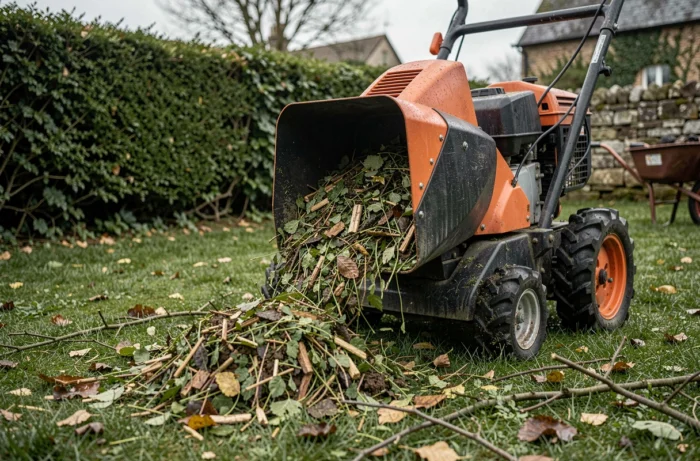
On a larger property or in the absence of an accessible outlet, the gas shredder takes over. Its superior power allows it to handle larger diameter branches without straining, and it is not dependent on any cable. Feedback varies on the ease of starting depending on the models, but gas engines remain the benchmark for large pruning volumes.
A factor rarely mentioned in standard guides: prefectural orders limit the use of shredders during dry periods. For several summers, some departments have prohibited shredding during specific time slots (typically in the middle of the day) when the fire risk is high. An electric shredder, which produces neither sparks nor exhaust heat, poses fewer problems in this context. If you plan to shred in the summer to mulch before the heat waves, this constraint influences the choice.
Battery-powered shredders: mobility versus autonomy
Wireless models are gaining ground. Their mobility is real, but their autonomy and torque lag behind wired models of equivalent power. For a hedge of privet or light pruning, it works. However, to turn a large pile of apple branches into mulch, you quickly reach the limits.
Cutting diameter and type of plants: adapt the machine to the garden
Before comparing models, take stock of what you are actually pruning. A garden with laurel hedges and a few rose bushes does not require the same machine as a property bordered by oaks and ashes.
- Soft branches up to 25 mm: an entry-level electric blade shredder is sufficient. The mulch will be fibrous but usable as light mulch for annuals.
- Semi-woody branches up to 40 mm: switch to an electric rotor shredder. The gear torque absorbs hard branches without jamming, and the mulch resembles usable chips.
- Hard branches over 40 mm: a gas shredder or a high-power electric shredder with a turbine system. It produces dense mulch, ideal for thick mulching on perennials or around fruit trees.
There’s no need to oversize the machine if the garden only generates light pruning. A shredder that is too powerful for the use costs more, weighs more, and requires more demanding engine maintenance.
Shredder maintenance and long-term mulch quality
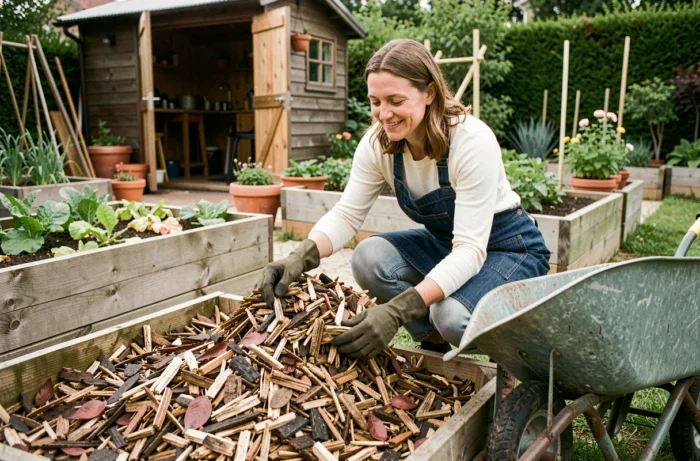
Dull blades no longer cut; they tear. The mulch produced by a poorly maintained shredder is fibrous, decomposes unevenly, and provides less protection for the soil. Sharpening or replacing the blades at least once a season ensures consistent results.
On a rotor shredder, the counter-blade also wears out. When the gap between the rotor and the counter-blade increases, fine branches pass through without being cut. You end up with intact stem pieces mixed in with the mulch, which degrades the ground cover.
The other point of attention concerns cleaning after each session. Residues of sap (especially on conifers and thujas) clog the mechanism and accelerate corrosion. A jet of water and a brush after use significantly extend the machine’s lifespan.
Valuing green waste rather than burning it
The ban on burning green waste, reinforced by the AGEC law and the texts of the Environmental Code, makes shredding the default solution for waste recovery. Turning your prunings into mulch instead of sending them to the dump reduces trips and nourishes the soil instead of depleting it. A well-chosen shredder pays back its investment in just a few seasons through savings on purchased mulch from garden centers.
The final choice depends on three intersecting parameters: the maximum diameter of branches to be processed, the frequency of shredding, and the desired fineness of the mulch for the type of mulching intended. An electric rotor shredder covers the majority of gardens. For properties with large subjects to prune regularly, the gas model remains the reference machine.