
The advertising posters installed in JCDecaux bus shelters are replaced according to a precise schedule. Each advertising campaign has a limited duration, after which the visuals are removed by field agents to make way for the next ones. These posters, often printed on large format paper with carefully crafted visuals, usually end up destroyed. However, there is a simple and legal method to recover them before they are thrown away.
How the replacement of posters at JCDecaux bus shelters works
The JCDecaux urban furniture operates in campaign cycles. Each advertising panel displays a visual for one to two weeks, sometimes longer depending on the contract. At the end of the display period, specialized agents visit each bus shelter to remove the old posters and install the new ones.
This replacement follows a regular schedule. JCDecaux France has publicly confirmed that poster changes occur on Wednesday and Thursday mornings, between 4 AM and 2 PM. The agents work early to minimize disruption in high-traffic areas. Each route covers a defined geographical sector, meaning that all bus shelters in the same neighborhood are serviced on the same day.
The removed posters have no commercial value for JCDecaux anymore. The campaign is over, and the medium has fulfilled its purpose. In most cases, these visuals are sent for recycling or to the dumpster. It is precisely this transition window that allows for requests to be made.
For those who wish to recover JCDecaux advertising posters before their destruction, the process relies on direct exchange with the agents in the field.
Requesting a poster from JCDecaux agents: the only reliable method
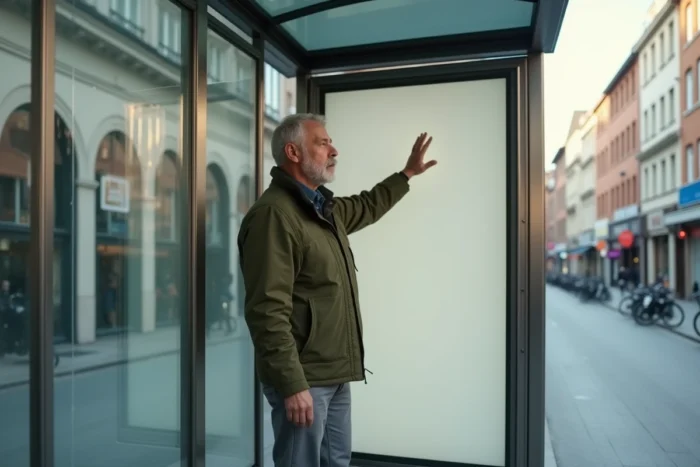
The procedure is simpler than one might think. The agents give away the posters upon simple request, provided you are present at the time of replacement. No forms, no prior administrative steps.
Specifically, this means identifying a bus shelter whose advertising campaign is coming to an end, then going there on a Wednesday or Thursday morning, ideally before 8 AM. The agents often start very early and only stay for a few minutes per panel.
Identifying the right moment
Some communication campaigns display their end date directly on the panel, at the bottom of the visual. When this mention is absent, observing the duration of exposure remains the best indicator. A poster visible for more than a week is likely to be replaced soon.
The regularity of the rounds also facilitates spotting. By passing by the same bus shelter several times at the beginning of the week, one can quickly identify the exact replacement day in their neighborhood.
What to know before showing up
- The agent has no obligation to give the poster. The process relies on goodwill, not an acquired right. Remain courteous and do not insist in case of refusal.
- Some posters may tear during removal, especially those glued in multiple strips. One-piece visuals (like the standard or rolling panel formats) tend to hold up better.
- The most requested posters (movies, cultural events, artistic visuals) go quickly. If several people show up, priority goes to the first one arrived.
Bus shelters, totems, rolling panels: not all supports are equal
The JCDecaux urban furniture includes several types of display supports. Each has specific characteristics that directly influence the quality of the recovered poster.
The classic bus shelter panels host large format posters, often made up of several strips glued side by side. The removal often damages the visual at the joints. The result heavily depends on the care taken by the agent and the type of glue used.
The totems (light panels on stands, visible from both sides) generally use single-piece posters, slid into a frame. These posters come out intact in the vast majority of cases, making them the most interesting support for recovery.
The rolling panels, present in some recent bus shelters, display several visuals in rotation. The mechanism stores the posters on an internal roll. During the campaign change, the agent removes the entire roll. Recovering a specific poster from this batch is possible but requires specifying which one at the time of exchange.
Legal framework and limits to respect for recovering an advertising poster
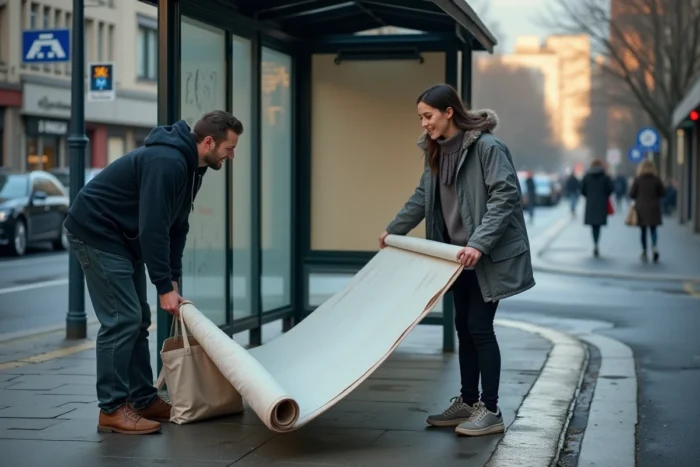
Requesting a poster from a JCDecaux agent during a scheduled replacement poses no legal issues. The poster has lost its commercial function, and the company explicitly tolerates this practice.
However, opening a bus shelter panel oneself constitutes an offense. The urban furniture belongs to JCDecaux or the local authority depending on the contracts. Forcing a lock, using an unauthorized key, or damaging the frame to access the poster exposes one to prosecution for damage to public property or theft.
The distinction is clear: recovering a poster given by an agent is legal, while taking it oneself is not. Some documents circulating online describe techniques for opening panels with specific keys. These methods, even if they do not require force, are still considered akin to breaking and entering into urban furniture.
Furthermore, local authorities are tightening control over illegal advertising around bus shelters, particularly under the Local Tax on Outdoor Advertising (TLPE). Posters not removed after a campaign are considered waste. Placing one’s own visuals on or near a bus shelter exposes one to municipal sanctions.
What to do with a recovered bus shelter poster
The format of bus shelter posters (approximately 120 x 176 cm for a standard panel) complicates traditional framing. A few options allow for their use without disproportionate investment.
- Mounting on a rigid support (foam board, Dibond) at a printer or framing shop. The cleanest solution for durable wall display.
- Direct attachment to the wall with magnetic clips or wooden poster strips, which avoids bending or cutting the visual.
- Storing flat in a large diameter cardboard tube, useful for collectors who store multiple posters.
Posters from advertising campaigns signed by recognized art directors or related to cultural events sometimes gain value in the collector’s market. Some cinema visuals in bus shelter format are resold on specialized platforms, provided they are in good condition and not folded.
Recovering JCDecaux posters remains a niche practice, accessible as long as one respects the replacement schedule and directly approaches the agents. The entire process relies on a cordial exchange, with no guarantee of availability, which is also part of the appeal of the approach.