
Fly eggs on meat pose a problem that goes beyond mere visual disgust. The bacterial contamination associated with necrophagous diptera (Calliphoridae, Sarcophagidae) makes the piece potentially dangerous well beyond the physical presence of the eggs. Here, we detail the technical protocols for assessing, treating, or discarding exposed meat.
Diffuse bacterial contamination: the real risk behind fly eggs
The mechanical removal of eggs does not solve the problem. Blowflies do not just lay eggs: they regurgitate digestive juices and deposit pathogenic bacteria on the entire contact surface. Salmonella, E. coli, and Campylobacter are among the agents identified by ANSES and EFSA on meats exposed to diptera.
The contamination is diffuse. It penetrates the superficial muscle fibers within minutes, especially on meat at room temperature. Scraping or rinsing the laying area only removes the visible fraction of the problem.
We regularly observe confusion in public guides: they recommend rinsing with white vinegar and then cooking thoroughly, as if these two steps were sufficient to ensure safety. In reality, ANSES recommends discarding any visibly infested meat as a precautionary principle. Cooking destroys some of the pathogens, but it does not neutralize certain bacterial toxins already produced on the surface.
To properly understand how to get rid of fly eggs on meat, one must first accept that physical removal is only a step and never a guarantee of safety.
Freezing contaminated meat: a false sanitary solution

Freezing a piece that is already infested kills the eggs and any potential larvae. This point is not contested. However, freezing does not destroy the pathogenic bacteria deposited by the fly. They enter dormancy and resume their growth once thawed.
This distinction between action on larvae and action on bacteria is often absent from popular recommendations. Freezing remains a preservation tool, not a decontamination protocol.
We recommend never freezing exposed meat with the aim of “making it safe.” If the piece has been left out in the open for more than a few minutes in the presence of active flies and eggs are visible, putting it in the freezer does not change the sanitary verdict.
Mechanical removal and rinsing: protocol and technical limits
If contamination has just occurred (egg laying observed within minutes, meat still fresh and cold), a removal protocol can be attempted. It does not guarantee safety, but it reduces the load.
- Remove the clusters of eggs using the back of a clean knife, scraping the surface without crushing the eggs into the fibers
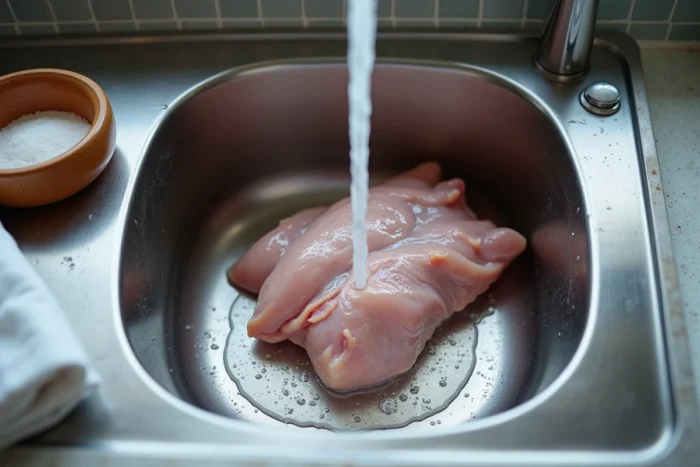
- Rinse the area under a stream of cold water, then apply a solution of diluted white vinegar (about one part vinegar to three parts water) over the entire exposed surface
- Pat dry with clean paper towels and visually inspect under good light; Calliphoridae eggs measure just over one millimeter and can hide in crevices
- Cook immediately to the core, without resting at room temperature, aiming for a sufficient internal temperature to destroy the vegetative bacterial forms
This protocol only applies to very recent contamination on meat that has remained cold. If the meat has been at room temperature for an extended period, bacterial multiplication renders rinsing ineffective.
Prevention in the kitchen and outdoors: physical barriers against laying
Prevention remains more reliable than any curative treatment. Blowflies detect the volatile compounds of protein decomposition from a distance and lay eggs within seconds of contact.
- Always use a food cover or fine mesh cloth over any exposed meat, including during cutting
- In bushcraft or barbecue situations, keep the meat in a closed cooler until cooking, without any buffer time in the open air
- In the kitchen, close windows without screens during preparation, or work under a functioning extractor hood
- Immediately clean cutting surfaces and meat juices, which attract secondary laying
Physical protection is paramount over any repellent. Essential oil or vinegar spray solutions reduce the attractiveness of the area, but they do not provide a reliable barrier against a fly determined to lay eggs.
Blowflies in the domestic environment: identifying an established infestation
The repeated presence of blowflies in the house often signals a laying site established elsewhere than on the countertop. Non-sealed trash cans, leftover meat in poorly managed compost, or a dead animal in a sanitary void are common sources.
We recommend treating the source rather than individual flies. A vinegar trap or sticky tape captures adults, but as long as the laying substrate exists, the population renews. Inspection should cover hard-to-reach areas: under furniture, ducts, garbage rooms.
Cleaning the source with a diluted bleach solution, followed by thorough drying, removes the site’s attractiveness for pregnant females. In case of persistent infestation despite these measures, a professional diagnosis can identify a hidden source.
Managing fly eggs on meat boils down to a fundamental rule: physical barriers before laying are better than any cleaning protocol afterward. When contamination has occurred, the decision to keep or discard the piece depends on the elapsed time, the temperature of the meat, and the visibility of the laying. When in doubt, the precautionary principle remains the safest response.