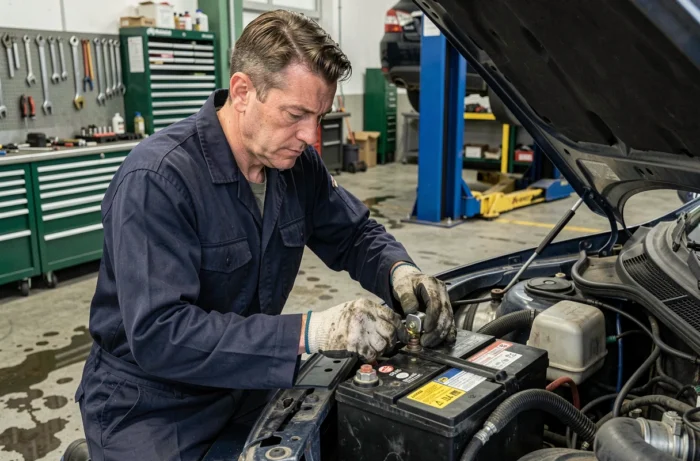
We connect the new battery, turn the key, and there: the Start-Stop no longer activates, the electric windows refuse to go up automatically, and a check engine light stays on. The power cut has erased part of the parameters stored by the vehicle’s computers.
Resetting your car after a battery change is not just about setting the clock: on newer models, it is an operation that affects the longevity of the new battery and the normal functioning of the onboard electronics.
BMS Registration on Start-Stop Vehicles: The Step Many Skip
On most European cars equipped with a Start-Stop system and energy recovery during braking, installing a new battery without registering it with the computer poses a real problem. The BMS (Battery Management System) continues to manage the charge according to the profile of the old, worn-out battery.
In practical terms, the computer remains in “degraded battery” mode. The Start-Stop deactivates, the alternator no longer regulates the charge appropriately, and the new battery ages prematurely because it undergoes cycles that are not suited to its actual state.
The registration involves erasing the history of the old battery via the OBD-II port, then entering the technology (AGM or EFB) and the capacity of the new one. On certain BMW, Audi, Mercedes, or Volvo models, the manufacturer code must also be provided. Without a compatible diagnostic tool, the operation cannot be performed by oneself. Several garages charge for this coding as a separate service, distinct from the physical battery replacement.
This topic is frequently covered in detail in auto news on Blog Automobile, especially for German models where the procedure varies from generation to generation.
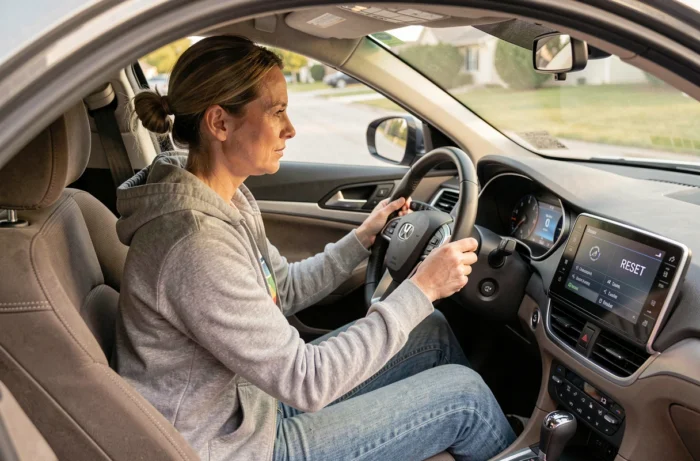
Resetting Electric Windows and Sunroof: Recalibrating the End Stops
After a power cut, electric windows often lose their “one-touch” function (full up or down with one push). The computer no longer knows where the upper and lower stops are. The sunroof, if present, is affected by the same mechanism.
The recalibration procedure is simple but must be complete. For each window:
- Hold the button down until fully open, then hold for another two to three seconds after reaching the lower stop.
- Without releasing, hold the button up until fully closed, then hold for another two to three seconds after reaching the upper stop.
- Repeat the operation on each door. On some models (Renault, Peugeot), the driver’s control must be used for each window, not the local control of the passenger door.
If only one window out of four is recalibrated, the pinch protection function may remain inactive on the others. This is a safety point, not just a comfort issue.
Dashboard Lights and Fault Codes After Battery Replacement
A check engine light or airbag warning that stays on after a battery change does not necessarily indicate a malfunction. The power cut generates fault codes in the computer’s memory. These codes persist until they are cleared, even if the original problem (the weak battery) is resolved.
On newer vehicles, an OBD-II reader is sufficient to read and clear fault codes. Entry-level devices sold for around twenty euros allow this operation via a smartphone app. You connect the reader to the OBD port (usually under the steering wheel on the driver’s side), initiate a scan, and clear the inactive codes.
Note: if a warning light returns after clearing and a few kilometers of driving, the fault is real and not related to the battery cut. In this case, a more in-depth diagnosis is required.
Special Case: Electric Power Steering Light
On several Peugeot and Citroën models, the electric power steering requires learning the center point of the steering wheel after reconnecting the battery. Turning fully left and then fully right, with the engine running, generally allows the computer to regain its reference points. Feedback varies on this point depending on the vehicle generations, but the manipulation remains risk-free.
Unstable Engine Idle and Throttle Body Relearning
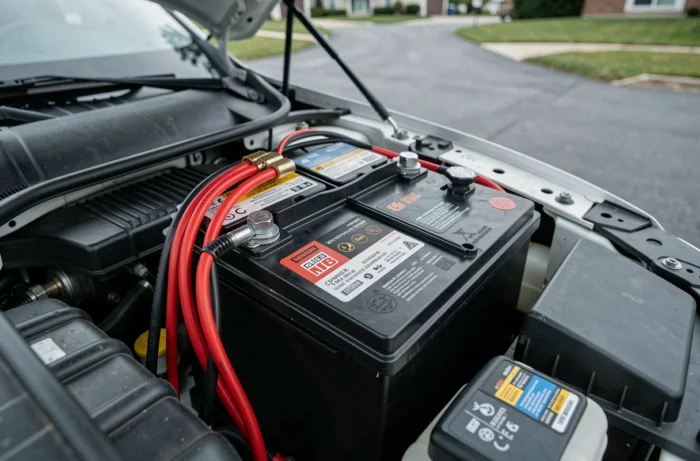
After reconnection, the engine may idle irregularly, or even stall at the first stops. The engine computer has lost its adaptive values: the positioning of the electronic throttle body, the richness corrections, the injection times learned over the kilometers.
The relearning occurs naturally while driving, but the process can be accelerated. The most common method:
- Start the cold engine and let it idle without touching the accelerator until the cooling fan turns on (indicating that the engine has reached its operating temperature).
- Turn off the ignition, wait about ten seconds, then restart.
- Take a mixed trip (city and highway) of about twenty minutes for the computer to recalculate its injection and ignition parameters.
On recent diesel engines with a controlled EGR valve, the recalibration may take longer. If the idle remains unstable after about a hundred kilometers, a diagnostic check is necessary to ensure that a sensor has not disconnected during the operation.
The reset after a battery change affects more systems than one might think, especially on vehicles produced since the mid-2010s. BMS registration, recalibrating the openings, and engine relearning form a trio of manipulations that should not be overlooked. Keeping an OBD-II reader in the glove compartment remains the most direct way to maintain control over the electronics of your vehicle without always going through the workshop.


