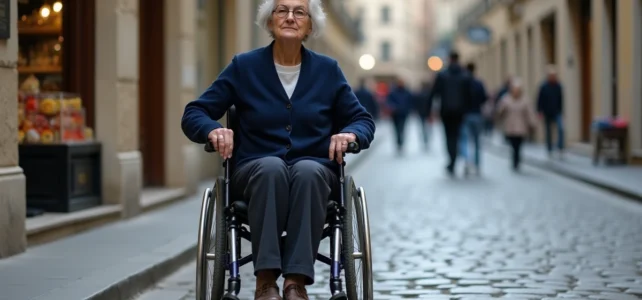
Taking the bus for a medical appointment, filling out an online form for housing assistance, crossing the threshold of a local shop: these mundane actions become obstacle courses when moving in a wheelchair, with a cane, or a walker. In France, the proportion of residents aged 65 or older now exceeds one-fifth of the population.
The challenges for people with reduced mobility go far beyond the access ramp: they touch on digital access, employment, housing, and daily autonomy.
Online public services: the weak link in PMR accessibility
Have you ever tried to fill out an administrative form on a website where the buttons don’t respond to the keyboard or where the contrast makes the text unreadable? For a person with reduced mobility who cannot physically go to the prefecture or town hall, this problem becomes a wall.
Twenty years after the 2005 Disability Act, only 7% of online public services are accessible to disabled individuals, according to an analysis by CFDT-UFETAM published in 2024. Article 47 of this law, however, mandates digital accessibility as a right. The gap between the text and reality is massive.
The dematerialization of procedures (health, employment, social assistance, housing) has often become the only practical access route for those who have difficulty moving. When this route is itself inaccessible, the direct consequence is a forced dependence on a third party (family, caregiver, social worker) for actions that are supposed to be achievable independently. This is no longer a technical problem; it is a regression of rights.
The situation concerns people with reduced mobility in France in the broad sense, including the elderly, parents with strollers, or temporary injuries, representing a much larger audience than just those recognized as disabled.

Accessibility of public transport: beyond the announcements
Raised bus stops, ramps in train stations, audible announcements in the metro: these facilities exist, but their deployment remains very uneven across different regions. In rural areas, the availability of adapted transport is often limited to a few slots per week, which conditions social life to an imposed schedule.
A recent example illustrates the persistence of the problem: in 2026, Le Monde reported a series of failures in the care of people with reduced mobility at Parisian airports, with travelers describing being “treated like luggage.” Air transport concentrates dysfunctions, but urban transport is not spared. In Marseille, residents are still demanding truly accessible buses.
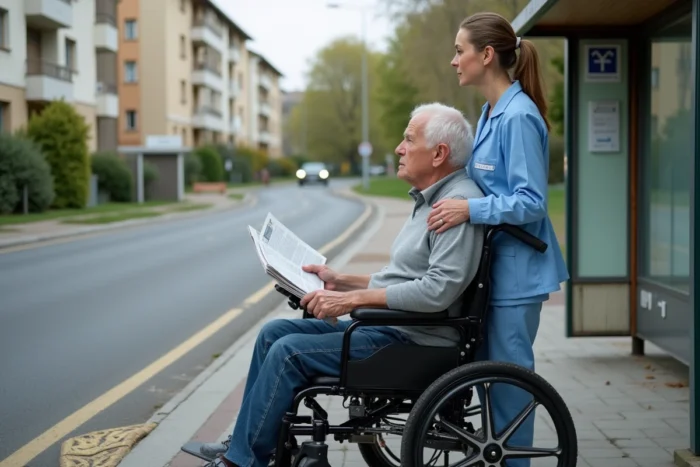
The accessibility of the transport chain must be continuous to be useful. An access ramp to the bus is useless if the sidewalk leading to the stop is impassable, if the pedestrian crossing has no lowered curb, or if passenger information is only visual.
What concretely blocks daily life
- Degraded or poorly designed roadways: curbs that are too high, uneven surfaces, poorly placed bollards that reduce the width of passage for a wheelchair.
- Inaccessible passenger information: schedules displayed only in small print, mobile apps not compatible with screen readers, absence of audible announcements at stops.
- Lack of coordination between modes of transport: a journey that combines bus, tram, and train can fail due to a single accessibility break along the route.
Adapted housing for PMR: an insufficient stock facing demand
Finding accessible housing when using a wheelchair often feels like an obstacle course. Accessibility standards for new constructions exist, but the existing stock remains largely unsuitable. Too narrow elevators, bathrooms that cannot be adapted, elevated thresholds at the entrance: the obstacles are concrete and costly to correct.
Financial assistance for housing adaptation (subsidies from the National Housing Agency, departmental aids, disability compensation benefits) exists, but their coordination is complex. A person with reduced mobility wishing to adapt their shower often has to compile a file with several organizations, with processing times measured in months.
The regulatory framework requires new housing to be “visitable” (access to the living room and toilets), but design that is truly adapted for daily use in a wheelchair remains rare in standard programs. The gap between “visitable” and “habitable” alone summarizes the discrepancy between the norm and the need.
Autonomy and employment: mobility as a barrier to professional integration
The difficulty in moving has a direct effect on access to employment. A home-to-work journey that takes twenty minutes by car can require two hours by adapted transport, when it exists. This additional time and energy cost leads some people to decline offers or limit their search to a very narrow area.
The Wimoov association, which regularly publishes a mobility barometer, documents the link between mobility precariousness and difficulty in integration. The barriers are not only physical: the cost of adapted transport, the absence of modified vehicles, or the lack of reserved parking spaces near workplaces contribute to this exclusion.
Reduced mobility acts as a multiplier of inequalities. It affects not only movement but also access to healthcare, training, leisure, and social life. For children with disabilities, the question arises as early as schooling, with schools whose accessibility remains partial.
Rights exist, and the legal framework is also in place. The 2005 law, the mobility orientation law, and European obligations regarding digital accessibility form a solid foundation on paper. The persistent gap with reality shows that the problem is no longer legal but operational.
As long as accessibility is treated as an optional adjustment rather than a basic condition, people with reduced mobility will continue to navigate an environment that has not been designed for them.