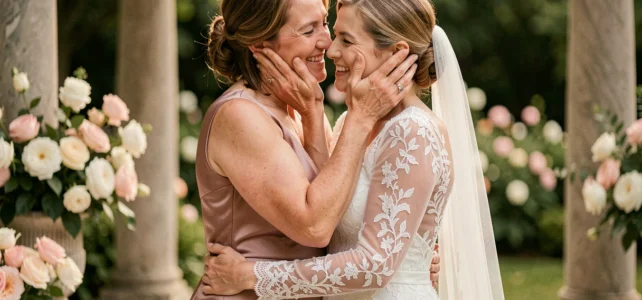
A daughter’s wedding is a moment overflowing with emotions, including for the parents who have accompanied her up to this point. Congratulating the bride’s parents is a way to acknowledge their role, their love, and sometimes their letting go. Finding the right words for this message requires some thought, as it is directed neither at the newlyweds nor at the family in general, but at two individuals experiencing a unique transition.
Why congratulating the bride’s parents changes everything
On the wedding day, all eyes are on the couple. The parents receive handshakes, a few hugs, but rarely a written message that is personally addressed to them. This is precisely what makes this attention so significant.
A word addressed to the parents does not replace the congratulations to the newlyweds. It highlights something else: the journey taken by an entire family. Mentioning the pride, the emotion, or even the hint of melancholy that a father or mother feels on that day offers a message that no one else will have thought to write.
As the advice from Le Blog Mariage reminds us, this type of message gains strength when it is sincere and personalized rather than based on a ready-made formula.
Memory, couple, wish: the most effective method for a touching message
You may have noticed that the messages that bring tears at weddings often follow the same thread? Event professionals now recommend a simple three-part structure for texts addressed to both parents and newlyweds: a concrete memory, a moment related to the couple, then a personal wish.
The concrete memory
Start with a specific memory related to the bride as a child or teenager, shared with her parents. Not a general statement like “you watched her grow up,” but a detail that only close ones know.
For example: “I remember the day when [first name] insisted on wearing her princess dress to school, and you gave in while laughing.” This kind of detail anchors the message in reality.
The couple’s moment
Follow up with an observation about the couple. Describe a moment when you realized that their daughter had found the right person, or mention a trait of the groom that the parents particularly appreciate.
A good message speaks about the couple through the parents’ eyes. This gives them the feeling that their judgment and happiness matter just as much as that of the newlyweds.
The personalized wish
Conclude with a wish that directly addresses the parents. Not a generic wish for happiness for the newlyweds, but something like: “May this new chapter bring you as much joy as you have given them.” The message closes on them, not on the couple.
Examples of congratulatory messages tailored to the tone
A message for the bride’s parents does not sound the same depending on your relationship with the family. Here are three tones to adapt according to the situation.
- Warm and understated tone: “Dear [first names], seeing [bride’s first name] so radiant today is seeing the reflection of all the love you have given her. Congratulations on this beautiful day; you deserve it as much as she does.”
- Complicit and personal tone: “Do you remember when [first name] swore she would never get married? Look at her today. You have done an extraordinary job, and it shows in her eyes. Enjoy every second.”
- Touching tone for close parents: “There are days that mark a parent’s life. This one is among them. [First name] is off to build her own family, but she takes with her everything that you are. With all my affection.”
Each message fits in a few lines. A short and precise text touches more than a long abstract letter.
Short speeches from parents: the trend that changes the game
Wedding planners have noticed a clear preference in recent years for short and conversational parental speeches, lasting around two to four minutes. The long, highly written texts of ten minutes, once common, are giving way to more natural speeches.
This evolution also applies to written messages. If you are writing a note to accompany a gift or a card, aim for conciseness. Three to five sentences are enough to convey a true emotion.
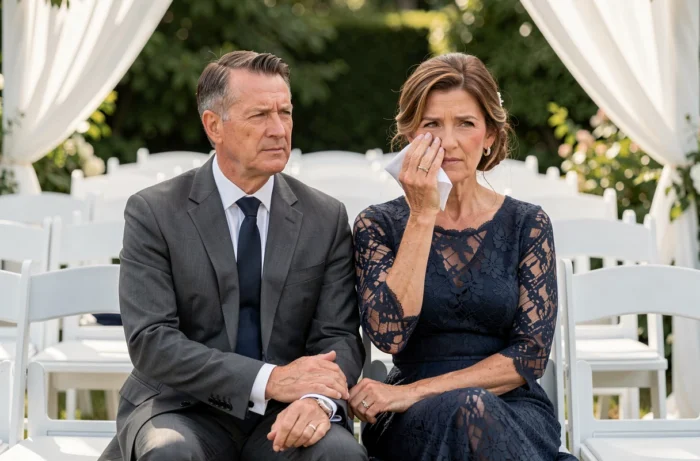
Why does this format work better? Because the emotion of the wedding is already at its peak. A concise message, with a single well-chosen memory, hits harder than a text that multiplies anecdotes and dilutes attention.
Card, guestbook, or letter: what medium to congratulate the parents
The medium of the message influences how it will be received and kept. A few options deserve to be compared.
- The card slipped into a bouquet or a gift: discreet format, read in private. Parents often discover it after the celebration, in a quiet moment where emotions can rise freely.
- The wedding guestbook: visible to all guests, reread years later by the couple and family. A message to the parents in the guestbook surprises, precisely because no one expects it.
- A handwritten letter sent a few days after the wedding: the rarest gesture, thus the most memorable. Parents receive mail once the celebration is over, at a time when returning to daily life can create a small emotional void.
The handwritten letter post-wedding is the most underestimated format. It arrives when parents no longer expect anything, which amplifies its effect.
Whatever the medium, avoid generic phrases like “all our best wishes for happiness.” Replace them with a personal detail, even minor, that shows the message was thought out for them and not copied from an online template. A first name, a memory, a specific quality of their daughter: it’s this kind of detail that transforms three polite sentences into a message that the bride’s parents will cherish for a long time.