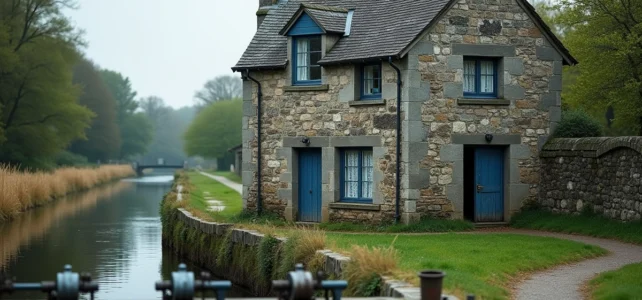
Breton lock houses charm with their location by the canal and their vernacular architecture. Buying a lock house in Brittany involves navigating between distinct legal regimes, recent environmental constraints, and usage obligations that have nothing to do with a classic real estate transaction. Understanding these differences before committing helps avoid months of unnecessary procedures.
Occupation agreement or declassification: two frameworks with opposing implications
The method of acquiring a lock house entirely depends on its attachment to the public river domain. Two frameworks coexist in Brittany, and their financial, legal, and practical consequences diverge on almost all points.
| Criterion | Temporary occupation agreement (COT) | Sale after declassification |
|---|---|---|
| Ownership of the building | Remains the property of the community or the State | Complete transfer to the buyer |
| Duration | Limited in time, renewable under conditions | Permanent |
| Works | Subject to authorization from the domain manager | Subject to common urban planning law and bank easements |
| Resale | Impossible (no ownership) | Free, subject to easements |
| Usage obligations | Frequent (maintenance, public access, activities) | Limited to classic easements |
The majority of lock houses offered in Brittany in recent years fall under the first case: a temporary occupation agreement, not a sale. The project holder does not buy a property; they obtain a usage right framed by a specifications document.
Anyone looking for a lock house for sale in Brittany must first check if the building has been declassified from the public domain. Without declassification, there is no sale in the legal sense, and the project takes a radically different direction.
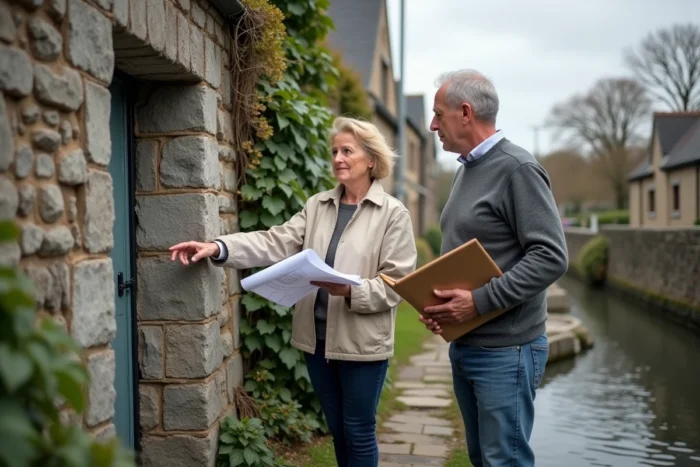
Calls for projects from Breton communities: what the specifications really impose
Several Breton intercommunalities are launching calls for projects to revive their lock houses. The Community of communes Bretagne romantique has, for example, published a specifications document for the tourist enhancement of the lock houses of Gacet, La Moucherie, and La Ségerie.
This type of document does not resemble a sales agreement. It defines maintenance, public access, and activity obligations that transform the residential project into an economic activity under pressure for results. The project holder commits to a specific program, evaluated by the community.
In Haute-Cornouaille, the Centre-Finistère has launched a similar initiative for two lock houses, with explicit objectives for revitalizing canal heritage. The response timeline, required documents, and selection criteria resemble more of a call for tenders than a negotiation between individuals.
Systematically required points in recent specifications
- A detailed economic or tourist activity project, with financial forecasts and implementation schedule
- Commitment to maintain regular public access, often for several months of the year
- Full responsibility for the maintenance of the building and its surroundings, according to standards defined by the canal manager
- Compliance with a validated work program, with prohibition on changing the property’s use without prior agreement
Responding to a call for projects without having measured these obligations amounts to engaging in an operation with narrow margins for maneuver. A pure residential project is rarely compatible with the expectations of managing communities.
Environmental constraints in wetland and riparian zones
Lock houses are, by definition, located by the canal or river, often in inventoried wetland areas. Recent policies for wetland preservation and stormwater management have tightened the conditions for development on these plots.
Development recommendations remind that the wetland functions as a hydraulic regulation system, not as ordinary buildable land. The objectives focus on reducing runoff and preventing flooding.
In practice, recent project call files include stricter clauses on several types of work:
- The creation of terraces, parking lots, or impermeable surfaces in immediate proximity to the canal
- The installation or renovation of non-collective sanitation systems, with reinforced requirements in wetland areas
- The installation of fences or modification of banks, subject to specific authorizations related to ecological continuity
A buyer planning to renovate a lock house to set up a gîte with a terrace and parking must anticipate these restrictions from the design phase. The cost of prior regulatory studies (wetland diagnosis, impact study, water law file) can represent a significant part of the overall budget.
Check the legal status before any steps: contacts in Brittany
The first reflex is to identify the manager of the relevant section of the canal. In Brittany, the management of waterways has been partially transferred to the Region as part of decentralization. The Brittany Region directly manages several canals, while some sections still fall under Voies navigables de France.
Verification process
Contacting the canal service of the Brittany Region allows you to find out if the building is still attached to the public domain or if it has been declassified. This information conditions the next steps: COT or classic sales deed.
At the same time, consulting the local urban planning plan of the municipality provides access to the easements applicable to the plot (hauling easement, passage easement, wetland). These easements persist even after declassification and permanently limit development possibilities.
The notary intervenes at the end of the chain, once the status is clarified. Incuring notary fees before obtaining written confirmation from the canal manager exposes one to costly disappointments. The chronology of the steps in this type of file is not trivial: it determines the very viability of the project.