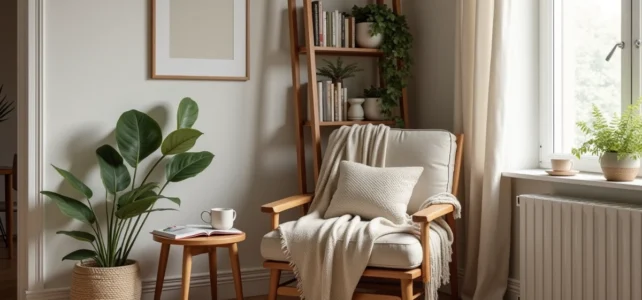
A squeaky sofa, a desk lamp in the living room, white walls since moving in: we all know that moment when the interior no longer feels like what we want to experience when coming home. Transforming your space into a trendy cocoon doesn’t require a complete renovation. A few targeted choices regarding materials, colors, and lighting are enough to radically change the atmosphere of a room.
Good ideas can be found in home articles on Neo News, which regularly address these topics from practical angles.
Duvet and bedding: the detail that changes the cocooning bedroom
We often talk about wall decoration or furniture, but rarely about bedding. Yet it is the first physical contact with the cocooning atmosphere, the one we feel every evening.
The concrete starting point: the size of the duvet determines the cocoon effect. A drop of 40 to 50 cm on each side of the mattress creates that enveloping sensation that bedding brands recommend in 2026. With a duvet of the right dimensions, you sleep “on” the bed rather than “in” the bed, and the difference in comfort is clear.
In terms of materials, the choice leans towards labeled and eco-friendly textiles. Crinkled linen adds an irregular texture that breaks the smooth and impersonal look. Certified OEKO-TEX organic cotton guarantees the absence of harmful substances in contact with the skin. Some French brands now offer made-in-France bedding that directly connects cocooning comfort and eco-responsibility.
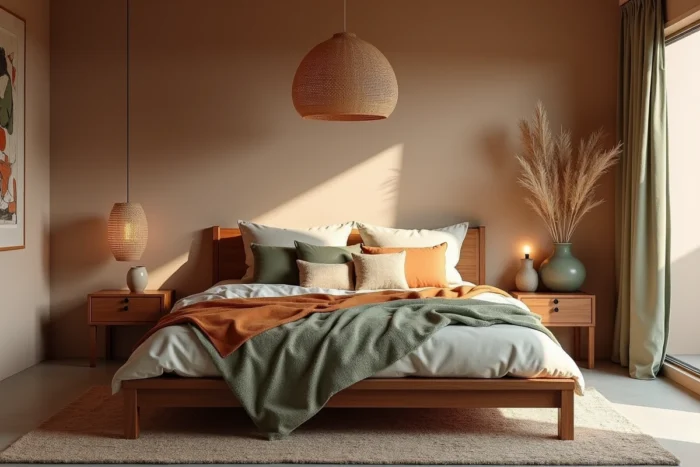
For the master bedroom, opt for covers in soft tones (ecru, greige, sage green) rather than pure white, which gives a hotel-like feel. A natural material bed throw placed at the foot of the bed is enough to visually structure the space without overwhelming it.
2026 Color Palette: Beyond Cocooning Beige
The total Scandinavian look (beige, light wood, off-white) has dominated interiors in recent years. The 2026 decor trends mark a retreat from this palette in favor of bolder tones.
Specifically, we are seeing a return of Mediterranean blues, olive greens, soft ochres, and terracotta. The idea is not to repaint the entire living room in midnight blue, but to introduce these colors in touches: an accent wall in the main room, cushions in warm tones, a tinted glass vase on a shelf.
The “sophisticated countryside” spirit sums up the direction well: mixing raw materials (textured stone, dark wood) with enveloping textiles in bold colors. The result is an interior that retains the warmth of cocooning without the beige uniformity that ended up flattening the spaces.
Combining colors without missteps
- Start with a neutral base (light walls, wooden floor) and add a single strong color per room, in two or three close shades
- Avoid multiplying saturated colors in a small space: it risks creating an overwhelming effect rather than a cocoon
- Test the shade on a wall exposed to natural light and observe the result in the evening, as ochres and terracotta change significantly depending on the lighting
Ambient lighting: replacing the ceiling light with multiple sources
A living room lit by a single central ceiling light produces flat light that kills any ambiance. Multiplying light points at different heights transforms the perception of the room.
The practical rule: three levels of light in each living space. A tall lamp (floor lamp or wall sconce), a mid-height lamp (table lamp, reading lamp), and a low source (string lights on the floor, candle). Each level divides the room into zones and creates depth.
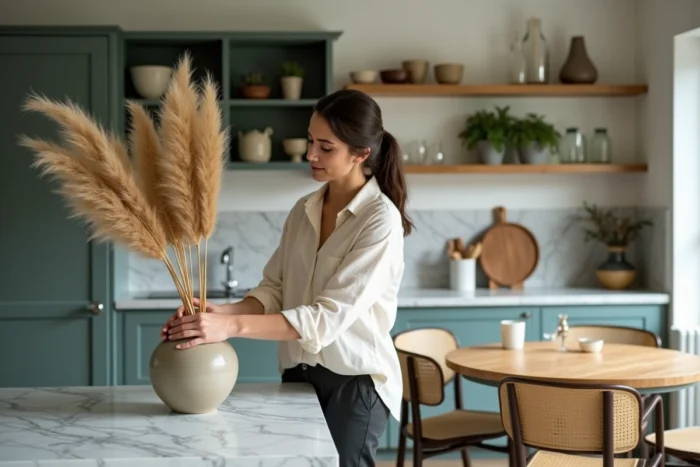
Choose warm temperature bulbs, around 2,700 kelvins, for living spaces. Feedback varies on this point according to personal preferences, but above 3,500 kelvins, the light tends towards cold white and breaks the cocooning effect. Lamps with dimmers allow for adjustment according to the time of day.
Wood and rattan lampshades filter light naturally, unlike metal or clear glass that diffuse without softening. A woven material lampshade casts soft shadows on the walls, adding a layer of visual texture without any additional decorative objects.
Textiles and natural materials: building comfort layer by layer
Cocooning relies on a controlled accumulation of textures. Not a chaotic pile of throws, but a thoughtful layering that invites touch.
In the living room, we start with the sofa. A model covered in textured fabric (corduroy, thick linen) catches light better than a smooth covering. We add two or three cushions in different materials: one in boucle wool, one in textured cotton, one in velvet. The contrast of materials creates visual richness, not the quantity of objects.
On the floor, a rug made of natural fibers (jute, wool, braided cotton) delineates the living room space and absorbs sound. In an open room, the rug acts as a visual separator without partitioning.
- Favor materials that age well: linen develops a patina, wool densifies, dark wood gains character over time
- Introduce one or two elements in textured stone or artisanal ceramics to break the overall softness and bring contrast
- Avoid shiny synthetic materials (polyester, lacquered plastic) that contradict the desired natural effect
A cocooning interior is not built in a weekend of shopping. The most successful spaces are those where each element has been chosen separately, sometimes months apart. Better to have a living room with five well-chosen objects than fifteen items bought in a set. Cocooning decoration gains authenticity when it reflects gradual choices rather than a catalog reproduced identically.