
A pain that radiates down the leg, a pinched nerve in a narrow passage of the spine: foraminal herniation raises very concrete questions for anyone wishing to continue moving. The good news is that physical activity remains not only possible but often recommended. However, it is essential to understand what distinguishes this hernia from others and to adapt movements accordingly.
Foraminal Herniation and Mechanical Constraints: What Changes Compared to a Classic Hernia
Most articles on sports and disc herniation discuss posterolateral hernias, which are the most common. The foraminal hernia, on the other hand, is located in the intervertebral foramen, this small bony tunnel through which the nerve root exits.
Why does this location change the situation? Because extension and lateral bending close the foramen. In practical terms, a pronounced arching movement or bending of the torso to the side of the hernia reduces the available space for the nerve. The result: a more pronounced radiculopathy, even with a low load on the spine.
With a posterolateral hernia, it is rather forward bending that poses a problem. With a foraminal hernia, the movements to monitor are different. Activities considered safe for a classic hernia (fast walking uphill, running with a strong lumbar lordosis, tennis with rotations and inclinations) can trigger foraminal pain. Knowing the prohibited sports with a foraminal hernia helps avoid movements that directly compress the nerve root in the foramen.
Before choosing an activity, it is therefore necessary to precisely identify the type of hernia and the affected vertebral level, usually L4-L5 or L5-S1 for lumbar forms.

Physical Activity and Lumbar Foraminal Herniation: Movements to Favor
You may have noticed that pain decreases in certain positions and increases in others? This is the key to choosing your exercises. Any activity that keeps the foramen open is potentially beneficial.
Gentle Flexion and Neutral Position Planking
Exercises in slight flexion of the spine open the intervertebral foramen. Ventral planking (plank) with a perfectly neutral back engages stabilizing muscles without compressing the nerve root. Swimming on the back, which places the spine in an elongated and unloaded position, is also well tolerated.
Walking on Flat Ground and Biking
Walking on flat ground remains a safe bet. However, prolonged uphill walking with a strong backward lean of the torso can worsen foraminal symptoms. Biking with a slightly low handlebar promotes gentle lumbar flexion, which tends to open the foraminal space.
Targeted Muscle Strengthening
Exercises to strengthen the trunk and lower limb muscles remain recommended, provided a few principles are followed:
- Work in a controlled range of motion, avoiding maximum lumbar extension or lateral bending on the side of the hernia
- Favor bilateral and symmetrical exercises (light squats, glute bridges) rather than unilateral movements with asymmetric loads
- Avoid overhead exercises with a bar (military press, heavy back squats) that impose marked lumbar arching
A systematic review on the effects of physical exercise in patients with lumbar disc herniation showed a favorable trend in pain reduction, whether the patient is operated on or not. This benefit pertains to adapted exercise, not sports practiced without caution.
Warning Signals During Effort: When to Stop
Moving is a good thing. But any pain radiating down the leg during exercise is an immediate stop signal. This is not just simple muscle soreness. It indicates that the nerve root is undergoing additional compression.
Three situations should lead to stopping the session and consulting:
- A sciatic-type pain that appears or increases during exercise, especially if it radiates below the knee
- Tingling or numbness in the foot or leg that did not exist before the session
- A sudden loss of strength in the leg, even briefly, during a movement that is usually habitual
The difference between normal muscle discomfort and neurological pain is clear: the former remains local and disappears at rest within a few minutes, while the latter radiates along the nerve pathway and may persist.
Adapting Progression: The Role of Time and Pain in Choosing Exercises
Tolerance to effort evolves over the weeks. An exercise that is painful today may become perfectly bearable in a month as inflammation decreases and stabilizing musculature strengthens.
The logic of progression is based on a simple principle: increase intensity or range only if the previous session did not provoke neurological symptoms in the following 24 hours. If an activity triggers radiating pain the next day, one must return to the previous level.
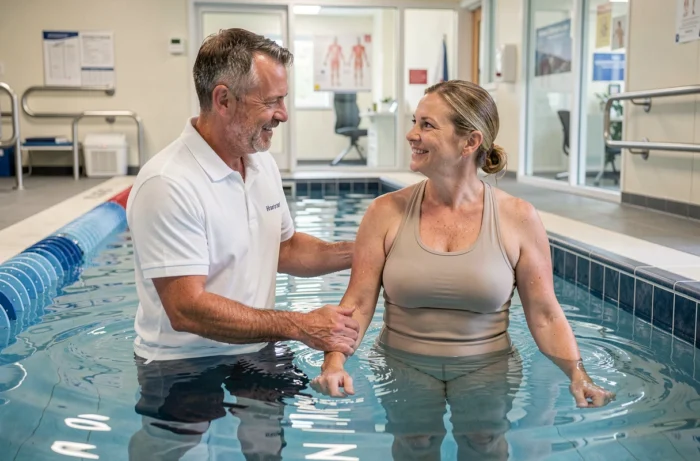
This stepwise approach works for both walking (duration, then terrain, then speed) and muscle strengthening (range, then load, then complexity of movement). A physiotherapist specialized in spinal pathology can guide this progression by testing the foramen’s tolerance in different positions.
A common pitfall is resuming high-impact activity (running, team sports) too quickly on the grounds that resting pain has disappeared. The absence of pain at rest does not mean that the nerve can withstand the repeated mechanical stresses of running or directional changes.
Foraminal herniation requires thinking in terms of foramen mechanics, not just lumbar pain. Choosing activities based on what opens or closes this narrow space is the difference between a sport that relieves and one that aggravates.


