
Tobacco purchased in Spain by a French resident is still subject to a dual legal framework: French customs rules on transport and, recently, a stricter Spanish legislation on consumption itself. Understanding these two aspects helps avoid penalties ranging from simple confiscation to fines of several thousand euros.
Electronic cigarettes and the new Spanish anti-tobacco law
Most articles on the subject focus on cartridge quotas. However, a recent change deserves particular attention: the new Spanish anti-tobacco law explicitly includes electronic cigarettes under the same regime as traditional cigarettes. Vaping devices, liquid refills, and heated tobacco are now treated the same way by Spanish law.
This text also introduces an unprecedented provision. For the first time, Spanish legislation no longer merely prohibits the sale or supply of tobacco to minors: it prohibits consumption itself by those under 18. A French teenager who smokes in Spain, even without having purchased the product locally, is subject to penalties.
For families crossing the border, this rule changes the game. The legislation on purchasing cigarettes in Spain is no longer just a matter of quantity transported: it also affects consumption practices on Spanish territory.
Allowed tobacco thresholds when returning to France from Spain
Spain is part of the European Union. Tobacco brought back to France must be intended for the personal consumption of the traveler, not for resale or significant gifting.
French customs apply indicative thresholds to assess the personal nature of the transport. Beyond these quantities, the burden of proof shifts: it is up to the traveler to demonstrate that the tobacco is indeed for personal use.
- Cigarettes: 200 units, or one carton
- Cigarillos (cigars weighing a maximum of 3 grams each): 100 units
- Cigars: 50 units
- Smoking tobacco (rolling, pipe): 250 grams
These thresholds are not absolute limits. Transporting more is theoretically possible if the traveler proves personal use, but customs officers consider several criteria: quantity, frequency of crossings, overall behavior, and means of transport used.
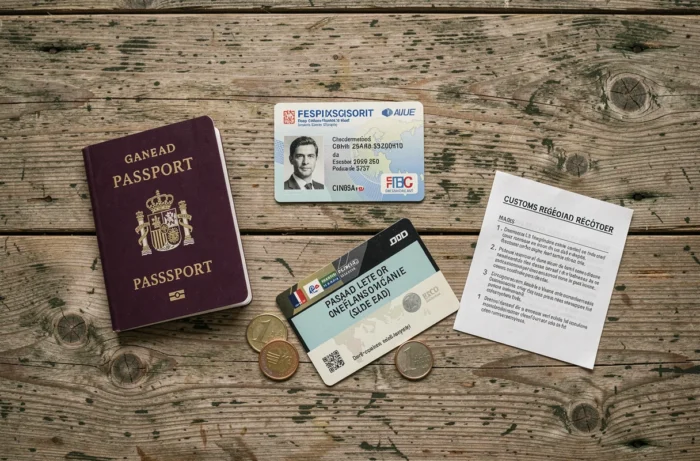
Criteria used by customs to qualify personal use
The customs code stipulates that agents evaluate the situation on a case-by-case basis. They particularly examine the status of the transporter (individual or merchant), the nature and quantity of the products, as well as the traveler’s declarations.
A regular route between southern France and Spain with quantities close to the threshold at each crossing constitutes a warning signal. Controls at the Franco-Spanish borders have been strengthened, increasing the likelihood of a physical vehicle check.
Penalties for exceeding tobacco quantities
Bringing back tobacco beyond the thresholds without being able to justify personal use exposes one to graduated penalties. The first consequence is the immediate confiscation of excess products.
Financially, customs fines can reach one to two times the value of the duties and taxes evaded. For larger volumes, transporting tobacco for commercial purposes without declaration falls under smuggling. The customs code provides for penalties that can include imprisonment in this case.
The distinction between personal use and commercial activity is based on a set of indicators. Even an individual who does not resell the tobacco but distributes it for free in large quantities can be reclassified.
Special case of Andorra and territories outside the European Union
Andorra, the Canary Islands, overseas departments and regions, as well as overseas collectivities do not fall under the intra-European Union regime. The allowed quantities there are significantly lower: the applicable exemptions correspond to those of third countries.
Confusing a purchase in Andorra (common for travelers passing through Catalonia) with a purchase in mainland Spain is a common mistake that can be costly at the French customs.
Tobacco prices in Spain and the differential with France
Spain voted for a tax increase on tobacco at the end of 2024, with increases applied progressively in 2025 and 2026. Prices in estancos (tobacco shops) are therefore rising regularly.

Despite this increase, brands like Marlboro remain around 5 to 6 euros per pack in Spain compared to over 13 euros in France. This price differential, which exceeds half of the French rate, explains the persistence of cross-border purchases by French smokers, particularly in areas near the Pyrenees.
However, the trend is towards a gradual narrowing of this gap. Spain is gradually aligning its tobacco taxation with average European levels, which reduces the financial advantage year by year. In the long term, the savings per carton may no longer justify a specific trip.
Strengthening of controls at the Franco-Spanish border
Controls at crossing points between France and Spain have intensified. This ramp-up concerns both road border posts and secondary routes used by individuals.
Customs officers have mobile control means deployed on departmental roads near the border, not just at highway tolls. A journey on secondary roads does not guarantee evasion of a check.
Cooperation between French and Spanish customs relies on data sharing within the Schengen area. A traveler checked multiple times with quantities close to the thresholds will have their profile flagged, increasing the likelihood of thorough checks during subsequent crossings.
The legal framework applicable to the transport of tobacco from Spain remains that of an intra-European market, with freedom of movement conditioned by strictly personal use. The gradual fiscal convergence between the two countries and the tightening of controls reduce the financial interest in these cross-border purchases, without prohibiting them.


