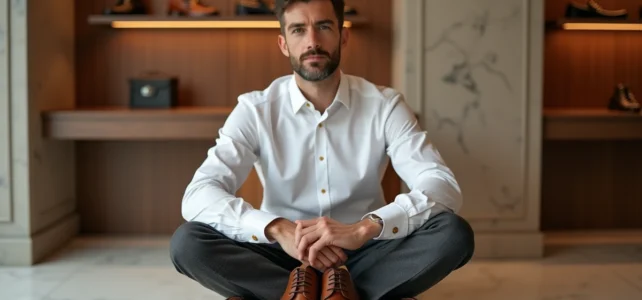
A pair of patinated leather oxfords, placed on a shelf, attracts the eye as much as a well-tailored suit. Luxury men’s shoes are not just about protecting the foot. They reveal a relationship with clothing, time, and material. The prestigious brands that dominate this segment share a common point: they invest as much in manufacturing as in the durability of their models.
Goodyear welt and Blake stitching: what separates a luxury shoe from a simply expensive one
Have you ever turned a shoe over to look at its sole? That’s the first reflex to adopt. The type of construction determines the longevity of the shoe, its ability to be resoled, and its long-term comfort.
The Goodyear welt, used by houses like John Lobb or Edward Green, involves stitching the leather upper to a welt (an intermediate leather strip), and then attaching the outer sole to this welt. Two distinct stitches, therefore. The result: a shoe that can be resoled multiple times without altering the upper structure.
The Blake stitching, more common among Italian shoemakers, goes directly through the insole, the upper, and the outer sole in a single stitch. The shoe is more flexible from the first wear, and also thinner. However, resoling is more delicate. To explore luxury men’s shoe brands that use these techniques, one must look beyond the logo and focus on the workshop.
A third construction, the Norwegian welt, offers superior waterproofing thanks to a visible leather flap around the perimeter. It can be found on high-end outdoor models from houses like Corthay or Alden.
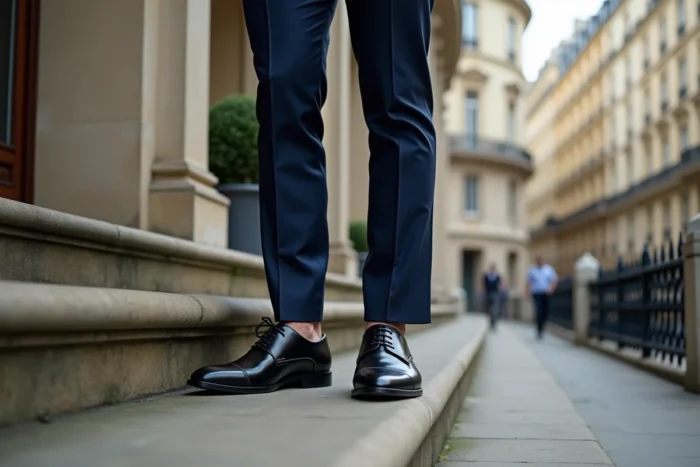
Full-grain leather, cordovan, suede: choosing the material according to use
Leather is not a uniform material. Its quality varies depending on the part of the hide used, the tanning process, and the finish. Knowing how to read these distinctions helps to better understand the price differences between two seemingly similar pairs.
- Full-grain leather: the top layer of the hide, the densest and most durable. It retains the natural grain and develops a patina over time. This is the standard for houses like Church’s or Crockett and Jones.
- Cordovan: derived from the horse’s rump, this very dense leather does not fold like regular leather. It forms waves instead of creases. Alden has made it a specialty, with models that have a waiting list extending for several months.
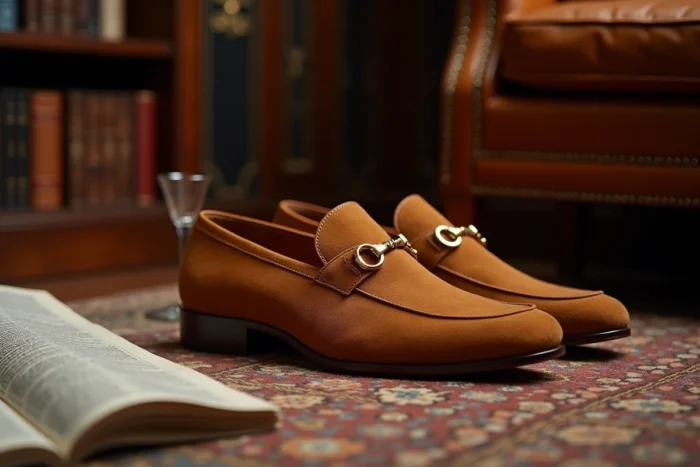
- Suede: the inner side of the hide, sanded to achieve a soft touch. Less water-resistant, it provides a different texture, suitable for derby shoes and loafers for mid-season.
High-quality leather is also recognized by its tanning. Vegetable tanning, done with bark extracts, produces stiffer soles that gradually mold to the foot. Chrome tanning, faster, yields softer leather but is less suitable for noble aging.
Regulation and transparency: what is changing for luxury shoe brands
The luxury men’s market is no longer just about product quality. Recent regulatory obligations are changing how houses manage their collections, stocks, and communication.
End of the destruction of unsold goods in Europe
The European regulation ESPR (Ecodesign for Sustainable Products Regulation) prohibits large companies from destroying their unsold textiles and shoes. The entry into force is set for July 19, 2026 for physical destruction, with an extension to SMEs planned for 2030.
In France, the AGEC law has already imposed since January 1, 2022, the mandatory valorization of unsold goods, prioritizing reuse and repurposing over simple recycling. For a house that produces a few hundred pairs per model, this constraint pushes to adjust production volumes rather than discounting in outlets.
Digital product passport and traceability
The ESPR regulation also provides for the introduction of a digital product passport. Each pair of shoes must be associated with an identifier tracing the origin of the materials, the place of manufacture, and the environmental footprint.
For the buyer, this is a concrete change. Instead of relying solely on a brand’s reputation, they will be able to verify if the leather comes from a certified tannery, if the construction was done in the claimed workshop, and if the production conditions match the stated commitments.
Leather care and resoling: making the most of a high-end pair
Buying a luxury shoe without maintaining it is like investing in a tailored suit and washing it in the machine. Leather is a living material that requires regular but simple care.
An appropriate polish (beeswax to nourish, pigmented cream to revive color) applied every two to three weeks is sufficient for most smooth leather models. Cedar shoe trees, inserted after each wear, absorb moisture and maintain the shape of the shoe.
Resoling, on the other hand, directly depends on the construction. A well-maintained Goodyear can be resoled three to five times, extending the lifespan of a pair to a decade or more. Some specialized cobblers also replace worn heels and leather pads for a few dozen euros, a negligible investment compared to the initial price.
Are you hesitating between two pairs? Favor the one whose construction allows for resoling. In the long run, a resolable pair costs less than a succession of disposable models, even branded ones.
The houses that are redefining masculine elegance today are distinguished not only by their style or history. They stand out by their ability to produce a durable, traceable, and repairable shoe. The next pair you choose will benefit from being judged on these three criteria as much as on its appearance.