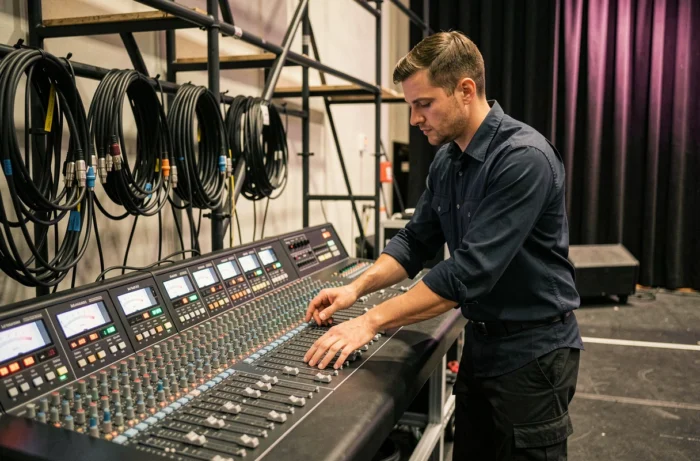
The choice of an audio and lighting system for an event is not just about stacking equipment on a stage. Since the tightening of regulations on amplified music, technical constraints have changed: regulated sound thresholds, continuous measurement requirements, and the obligation to provide hearing protection to the audience. These rules directly modify how to design an audio chain and select projectors.
Regulatory sound limits and impact on equipment choice
The decree of April 17, 2023, imposes specific thresholds on venues receiving the public: 102 dB(A) and 118 dB(C) over 15 minutes for an adult audience. Operators must continuously record sound levels, inform the public about hearing risks, and provide protections.
This constraint has a direct consequence on the equipment. Providers now integrate certified limiters and recorders into the audio chain, via DSP processors or dedicated limiters. A sound system must be able to deliver comfortable sound while staying below these thresholds, which excludes some oversized configurations that were once common in events.
When browsing all the equipment on 100,000 Watts, the question of sizing makes perfect sense: a well-calibrated compact line array system often covers a room better than a stack of subs pushed to the limit.
The sound emergence for nearby residents is another parameter. Outdoors or in a location close to residences, merely adhering to thresholds is not enough. It is also necessary to limit sound propagation beyond the event perimeter. Field feedback varies on this point: some providers favor controlled directivity speakers, while others rely on the strategic placement of sound sources to reduce unwanted reflections.
Event lighting: LED technology and DMX protocol
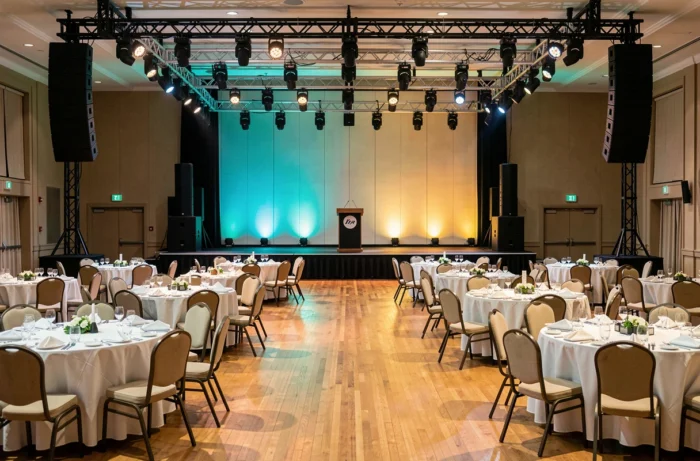
Almost all recent event installations rely on LED technology. The reasons are primarily practical: reduced power consumption, limited heat output, and a longer lifespan compared to discharge lamps.
The DMX protocol remains the control standard for operating stage projectors. It allows each device to be addressed individually from a console, managing intensity, color, movement, and effects. For a medium-sized event (seminar, corporate party, wedding), a basic DMX console paired with about ten LED projectors is sufficient to create varied atmospheres.
Projectors to know based on format
Not all projectors serve the same purpose. The choice depends on the event format and the desired effect.
- PAR LEDs provide wide and even ambient lighting, suitable for color walls, buffets, or reception areas.
- Moving heads (spots and washes) allow for dynamic effects and stage tracking, useful for concerts and shows.
- Profile spots offer a sharp and adjustable beam, preferred for conferences where it is necessary to illuminate a speaker without spilling onto the projection screen.
- Strobes and LED bars complement the setup for festive events, with programmable sequences via DMX.
A common pitfall is to multiply the types of projectors without coherence. An effective lighting plan relies on a maximum of three to four types of sources, combined according to a thoughtful scheme.
Indoor and outdoor sound reinforcement: two distinct technical logics
An audio system designed for a conference room does not work outdoors, and vice versa. Indoors, the acoustics of the venue (reverberation, wall materials, ceiling height) condition the choice of speakers and their positioning. A highly reverberant room requires narrow coverage speakers and equalization treatment to avoid sound mush.
Outdoors, the absence of reflective walls changes the game. Sound disperses quickly, necessitating higher power and closer placement of speakers to the audience. Line array systems are often favored outdoors for their ability to project sound over long distances with limited loss.
The issue of power supply also deserves attention. An outdoor event often requires a generator, whose power must cover the entire audio and lighting chain with a safety margin. Undersizing the electrical supply leads to cuts or distortions that compromise the performance.
Technical management and coordination on the day of the event
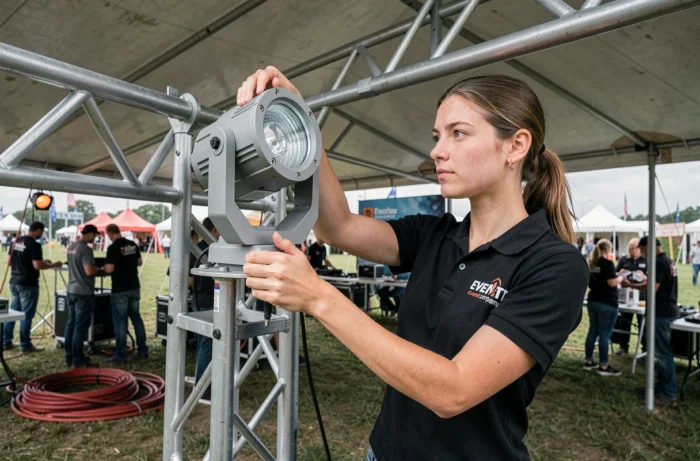
The equipment is only part of the equation. Technical management, meaning real-time control of sound and lighting, determines the quality perceived by the audience.
A sound engineer continuously adjusts levels: microphone volume according to speakers, balance between music and voice, management of stage returns. Without a dedicated engineer, even a high-end system can deliver poor sound. The lighting engineer, for their part, sequences programmed scenes on the DMX console and adapts the lighting to unforeseen events (a speaker’s delay, a last-minute change in ambiance).
For small-scale events (fewer than a hundred people), a versatile technician can manage both roles. Beyond that, separating functions remains the norm to ensure a smooth performance.
- Plan a sound check at least two hours before opening to the public, in real conditions (microphone on, music playing).
- Test each lighting circuit individually to identify faulty projectors before the event starts.
- Have a backup kit: XLR cables, power adapters, replacement microphone, fuses for projectors.
The reliability of an audio and lighting performance relies as much on logistical preparation as on the quality of the equipment. A well-sized system, compliant with regulatory thresholds, and operated by a competent technician covers the majority of event configurations, from corporate seminars to outdoor festivals.


