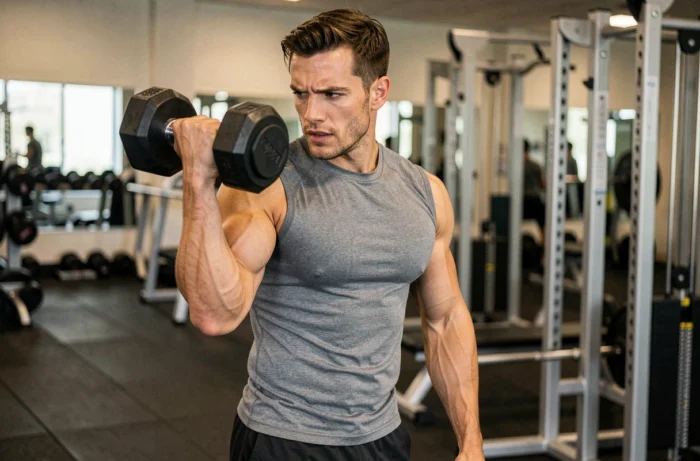
The dumbbell bicep curl targets three elbow flexor muscles, but EMG data shows that grip and bench angle significantly redistribute activation among these muscles. Comparing variations based on objective measurements allows for choosing the one that aligns with a specific goal, whether it be the volume of the biceps brachii, the thickness of the brachialis, or forearm work.
Muscle Activation by Grip: Supination, Hammer, and Pronation Curls
EMG studies, including those by Marcolin et al. (2018, PeerJ), indicate that overall activation of the biceps brachii is comparable between straight bar curls, EZ bar curls, and dumbbells at equivalent relative loads. The difference lies in the adjacent muscles.
| Grip Type | Main Muscle | Secondary Muscles Favored | Main Benefit |
|---|---|---|---|
| Supination (palm up) | Biceps brachii (short and long head) | Anterior brachialis (moderate) | Bicep volume and peak |
| Neutral / Hammer | Anterior brachialis | Brachioradialis (forearm) | Arm thickness, grip strength |
| Pronation (palm down) | Brachioradialis | Biceps brachii (low) | Forearm development |
This table shows that the choice of a variation does not rely on an assumed superiority of one exercise, but rather on the muscle one wishes to prioritize. A practitioner looking to thicken the outer arm has more to gain from incorporating hammer curls than from increasing the number of supination sets.
Mastering the dumbbell bicep curl in supination remains the logical starting point, as it recruits the largest surface area of the biceps brachii. Other grips complement the work, not replace it.
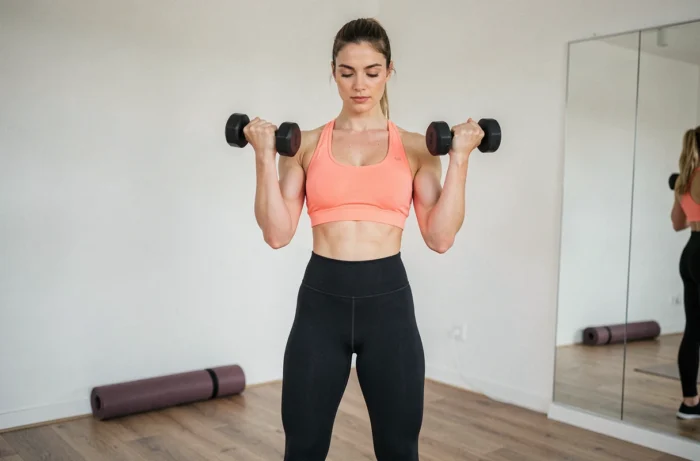
Incline Curl at 45 Degrees: An Angle That Protects the Shoulder
The incline curl on a bench is often recommended to stretch the long head of the biceps in the low position. The classic angle is around 60 degrees. Recent analyses focused on joint longevity indicate that this angle positions the humeral head forward in the anterior capsule, increasing the risk of subacromial impingement.
A bench set at 45 degrees reduces strain on the shoulder while maintaining sufficient stretching of the long head. The difference is noticeable from the first sets among practitioners who feel discomfort at the front of the shoulder in the classic incline position.
Indicators for Adjusting the Bench Angle
- Pain or pinching at the front of the shoulder in the low position: raise the angle by a few degrees or switch to 45 degrees
- No sensation of bicep stretch at the bottom of the movement: the angle is too vertical, lower it to around 45 degrees
- Difficulty keeping elbows fixed behind the torso: the load is too heavy for the chosen angle, reduce the weight before changing the incline
The bench angle is not a cosmetic detail. It alters the resistance curve and the distribution of joint stress. Adapting the incline to one’s shoulder morphology prevents chronic tendinitis that interrupts progress.
Frequency and Sets for Dumbbell Curls: What Bicep Recovery Allows
The biceps brachii is a relatively small muscle that recovers faster than larger muscle groups like the quadriceps or back. Two bicep sessions per week are sufficient for most practitioners looking to progress in volume.
Distributing the work over two sessions allows for maintaining a higher total volume of sets without accumulating excessive fatigue in a single session. Three to four sets per exercise, with repetitions between eight and twelve, form a coherent base for hypertrophy.
Common Mistake: Compensating for Stagnation with Volume
When progress stagnates, the common reflex is to add more sets or exercises. In reality, the bicep responds better to a gradual increase in load or a change in variation than to additional volume. Beyond ten direct weekly sets, the stimulus/fatigue ratio decreases for most intermediate levels.
Alternating between supination curls and hammer curls from one session to the next exposes the elbow to different stresses and engages the brachialis in addition to the biceps. This simple rotation covers all three elbow flexors without multiplying exercises.
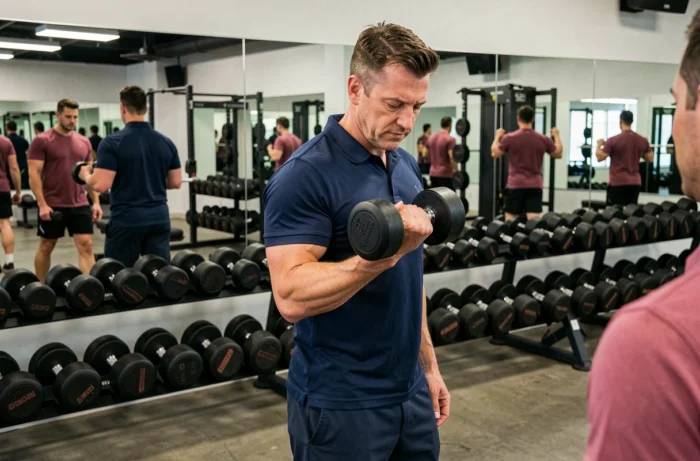
Elbow Position and Cheating: The Variable That Changes Everything in Dumbbell Curls
The elbow must remain fixed, slightly in front of the torso, throughout the concentric phase. As soon as the elbow moves back or forward to accommodate the load, the anterior deltoid takes over and the bicep loses a significant amount of mechanical tension.
The cheat curl (swinging the torso to lift the load) has its proponents among advanced practitioners who use it in controlled eccentric overload. For a beginner or intermediate level, this technique mainly increases the risk of lower back and elbow tendon injuries, without providing superior stimulus to the biceps.
A simple test: if the load requires moving the elbows back or arching the back, it is too heavy for a strict curl. Reduce the weight and control the eccentric phase over two to three seconds to produce longer muscle tension and more complete recruitment of the biceps brachii fibers.
The dumbbell bicep curl requires neither complex equipment nor sophisticated programming. The key factor that determines results remains the quality of the contraction, not the number of variations piled into a session. A strict curl, with a grip suited to the targeted muscle goal and a bench angle respectful of the shoulder, covers nearly all needs for arm development.


