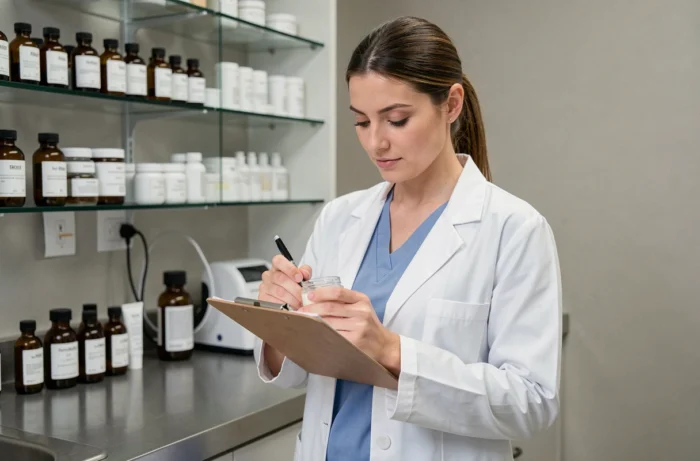
The cosmetologist formulates creams, serums, and hair care products in the laboratory. Their work is not limited to creating pleasant textures: in recent years, European regulations have significantly expanded the scope of their responsibilities, from cosmetic vigilance to the control of environmental claims. Understanding these missions helps to gauge the gap between the current perception of the profession and the daily technical reality.
Cosmetic Vigilance and Post-Market Monitoring: The Unrecognized Regulatory Mission
Formulating a cosmetic product is only part of the job. The cosmetologist also contributes to monitoring adverse effects after the product is on the market. In France, the DGCCRF controls products and establishments, while Anses receives and analyzes reports of skin reactions or allergies.
This cosmetic vigilance system imposes a permanent traceability requirement on formulation teams. Each report can trigger an analysis of the raw materials used, a re-examination of the product’s stability, or even a complete reformulation if an ingredient is implicated.
To better understand the roles on My French Touch, it is important to note that this regulatory dimension distinguishes the cosmetologist from a simple formulator. The profession requires constant scientific monitoring of health alerts and European regulatory developments.
Fragrance Allergens: What European Regulation 2023/1545 Changes for Cosmetic Formulation
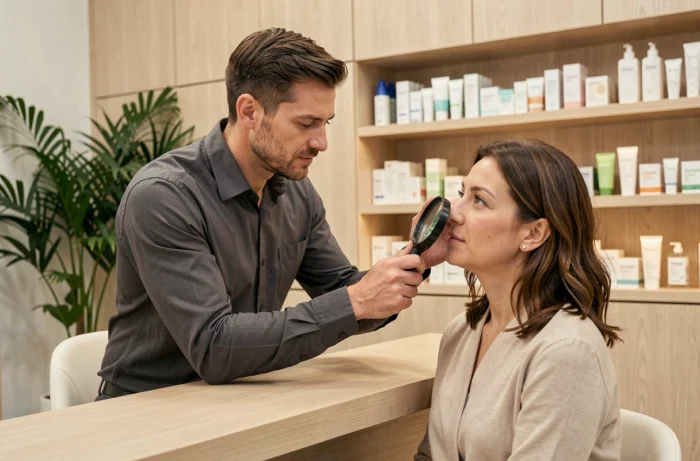
Regulation (EU) 2023/1545 has expanded the list of fragrance allergens that must be individually listed on labels. The list has increased from 26 substances to over 80. This change has direct consequences on the daily work of the cosmetologist.
Reformulating a scented serum or cream is not just about replacing one ingredient with another. The cosmetologist must check the compatibility of each substitute with the rest of the formula, restart stability tests, and ensure that the sensory profile remains consistent with the initial marketing brief.
| Before Regulation 2023/1545 | After Regulation 2023/1545 |
|---|---|
| 26 fragrance allergens to declare | More than 80 fragrance allergens to declare |
| Targeted analysis of raw materials | Enhanced traceability across the entire chain |
| Relatively simplified labeling | Systematic verification of packaging and claims |
| Occasional reformulation | Structural reformulation of entire ranges |
This table illustrates a concrete shift. The cosmetologist now spends more time on regulatory compliance than on pure creation. Rigor in analytical chemistry and dermo-cosmetics has become a daily prerequisite, not just an asset.
Environmental Claims: Strengthened European Regulation and Its Impact on Cosmetic Products
Since 2024, terms such as “clean,” “eco-friendly,” or “environmentally friendly” on cosmetic products are subject to strengthened regulation at the European level. The new rules target three practices:
- Sustainability labels displayed without certification from an independent body
- Generic environmental claims that are not based on any verifiable technical demonstration
- Promises based on carbon offsetting rather than a real reduction in the product’s impact
The cosmetologist becomes the technical guarantor of each claim made on the packaging. When the marketing department wants to assert an environmental benefit, it is up to the formulator to provide the formulation data, safety sheets, and analysis results that support this claim.
This regulatory competence goes beyond chemistry. It requires a precise understanding of European texts, the ability to communicate with legal services, and the capacity to refuse an unprovable claim, even under commercial pressure.
Cosmetic Formulation and Innovation: Between Chemistry, Dermo-Cosmetics, and Consumer Expectations

The design of a formula remains the foundation of the profession. The cosmetologist selects active ingredients based on a specification that combines efficacy, safety, and sensory experience. Each formula must simultaneously meet scientific, regulatory, and marketing constraints.
The formulation work varies depending on the product categories. A product intended for sensitive skin requires specific dermo-cosmetic tests and a limited selection of ingredients. A long-lasting makeup product demands tests for mechanical and thermal resistance.
The skills involved cover a wide spectrum:
- Organic and analytical chemistry to understand interactions between ingredients
- Skin biology to adapt formulas to different skin types
- Sensory evaluation techniques to measure texture, absorption, and fragrance
- Knowledge of industrial processes to ensure reproducibility in production
Access to the profession generally requires training in chemistry, biochemistry, or cosmetology, ranging from bac+2 to bac+5 depending on the targeted position. Research and development positions most often require a bac+5 with a specialization in formulation.
On the other hand, roles in quality control or safety assessment may be accessible with an intermediate degree, provided that regulatory frameworks are mastered.
The profession of cosmetologist has shifted its center of gravity. The regulatory aspect, once marginal, now occupies a significant fraction of working time. Between cosmetic vigilance, reformulation related to allergens, and verification of environmental claims, the cosmetic formulator operates at the intersection of chemistry, European law, and product strategy. This triple technical, legal, and sensory requirement defines the profile sought by employers in the beauty and aesthetics sector.


