
On a Clio 2, a steady immobilizer warning light does not always mean that the immobilization system is at fault. Before touching the wiring harness or considering reprogramming the engine control unit, identifying the exact source of the blockage helps avoid turning a minor issue into a permanent failure. Distinguishing between a key failure, a battery issue, a malfunction of the UCH, or a true immobilizer lock determines the entire course of the intervention.
Differential diagnosis before touching the Clio 2 immobilizer system
The common reflex when faced with a steady red warning light on the dashboard is to blame the immobilizer. This is often a diagnostic error. Several components produce exactly the same symptom, and confusing them leads to unnecessary, even destructive interventions on the control unit.
| Observed symptom | Probable cause | Appropriate action |
|---|---|---|
| Steady red light, starter does not turn | Weak battery or corroded terminal | Measure the voltage at the terminals (minimum required for UCH-ECU communication) |
| Steady red light, starter turns but engine does not start | Encoded key not recognized by the UCH | Test with the second key if available |
| Flashing red light then steady after a few minutes | Intermittent fault of the antenna around the ignition switch | Check the wiring of the transponder antenna |
| Steady red light, no electrical reaction | UCH out of service | Diagnosis via compatible tool before any manipulation |
A voltage that is too low at the battery terminals prevents communication between the key, the UCH, and the engine control unit. The system interprets this lack of dialogue as an unauthorized attempt and blocks the injection. Recharging or replacing the battery is then enough to restore starting without any intervention on the immobilizer.
The encoded key of the Clio 2 contains a passive transponder powered by the magnetic field of the antenna placed around the ignition switch. If the chip is damaged or if the antenna has a bad contact, the code is never transmitted to the UCH. The problem is mechanical or electrical, not software-related. Before considering to manually remove the Clio 2 immobilizer, checking these two points takes a few minutes and can make the operation unnecessary.
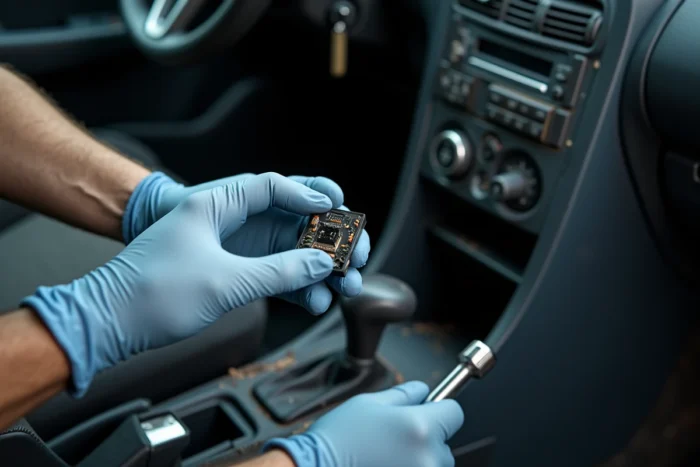
Decoder socket and UCH: what changes between Phase 1 and Phase 2
The Clio 2 Phase 1 (before 2001) has a decoder socket accessible under the dashboard. This socket allows the use of a hardware deactivation key to neutralize the immobilizer, provided that the vehicle’s PIN code is available. The intervention does not modify the wiring harness and remains reversible.
In contrast, this decoder socket does not exist on all Clio 2 Phase 2 (from 2001 onwards). On these models, the architecture relies more on digital dialogue between the UCH and the engine control unit. Manual deactivation by simply connecting a physical decoder is therefore not transposable.
Consequences for the deactivation method
On a Phase 1, the manual procedure remains relatively accessible for a DIY enthusiast equipped with the PIN code. The risk of permanently locking the control unit is low as long as the connections of the UCH unit are not modified.
On a Phase 2, attempting to bypass the immobilizer without a diagnostic tool capable of communicating with the UCH and the control unit exposes one to a permanent locking of the engine control unit. This risk, rarely mentioned in online tutorials, turns a repairable failure into a complete replacement of the engine electronics.
- Phase 1: locate the decoder socket under the steering column, insert the deactivation key with the PIN code, wait for confirmation by the extinction of the red light
- Phase 2: connect a compatible Renault diagnostic tool, read the faults stored in the UCH, identify whether the blockage comes from the transponder, the antenna, or the control unit before any attempt at deactivation
- Both phases: never cut the wires of the immobilizer unit without having precisely identified the electrical diagram of the concerned version, as the wiring differs according to the engines and model years
Manual procedure for deactivating the Clio 2 Phase 1 immobilizer
This method applies to models equipped with the decoder socket. It requires the PIN code written on the code card provided at the purchase of the vehicle. Without this code, the procedure is impossible manually.
Accessing the unit and identifying the connectors
Removing the lower cover under the steering wheel (generally two crosshead screws) gives access to the area where the UCH unit and the decoder socket are located. The socket appears as a two-pin connector, distinct from the other connectors in the harness.
The deactivation key connects to this socket. The ignition must be on without starting the engine. The entry of the PIN code is then done through a sequence of presses on the accelerator pedal, according to the number of digits in the code. Each digit corresponds to a number of presses, separated by a pause.
Validation and verification
If the sequence is correct, the immobilizer light goes out and starting becomes possible again. In case of an error, the system imposes an increasing waiting time before allowing a new attempt. After several consecutive errors, the control unit may temporarily lock, which may require waiting several tens of minutes.
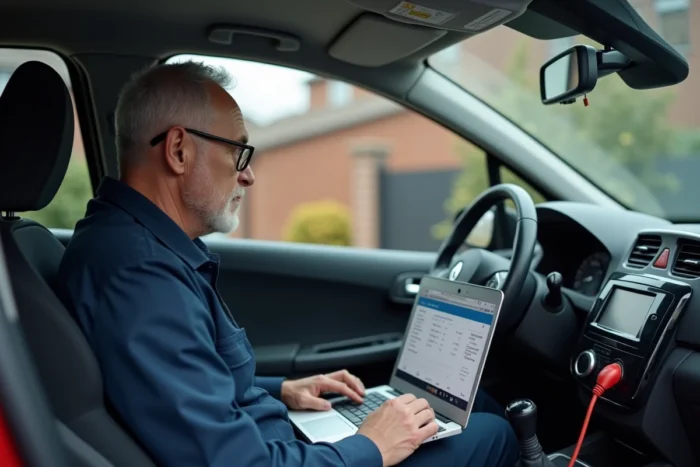
Concrete risks before reprogramming the engine control unit
Reprogramming the control unit to permanently remove the immobilizer function is a distinct operation from manual deactivation. It occurs downstream, once the diagnosis is made and the temporary deactivation is performed.
Starting a reprogramming on a control unit already locked by failed attempts worsens the situation. The control unit may enter protected mode, making any communication impossible, even with a professional tool. Replacing the entire UCH-control unit then represents a cost much higher than that of an initial diagnosis.
Two precautions reduce this risk. First, read the fault codes before any physical manipulation: a compatible Renault OBD reader is sufficient for basic engine faults. Then, ensure that the battery is fully charged throughout the duration of the intervention, as a power cut during reprogramming corrupts the control unit’s memory.
The immobilizer system of the Clio 2 protects the vehicle, but its complexity varies depending on the phase and model year. On a Phase 1, the decoder socket offers a reliable manual route. On a Phase 2, using a diagnostic tool is not a luxury but a technical necessity to preserve the engine control unit.