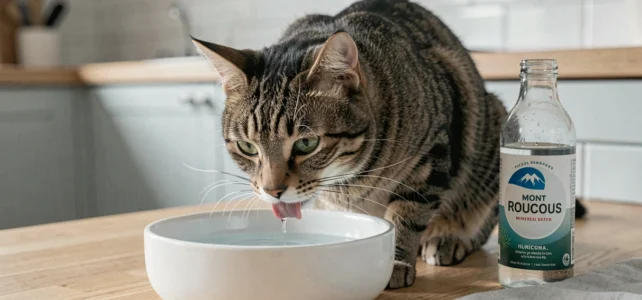
The cat poorly regulates its thirst. Its desert ancestor has left it with an abnormally high threshold for perceiving dehydration, which places the quality of drinking water as a direct nutritional lever, not just a simple comfort. Mont Roucous water, with its ultra-low mineral profile, meets a specific physiological constraint of the feline.
Dry residue and mineral load: what Mont Roucous brings to the cat’s renal metabolism
The feline kidney filters a proportionally higher plasma volume than that of dogs. Any overload of calcium, sodium, or magnesium ions increases tubular workload and, ultimately, the risk of urinary crystallization. This is where the choice of water becomes a preventive measure.
Mont Roucous has a dry residue of about 25 to 33 mg/L at 180 °C. This figure places it among the least mineralized waters available in France. By comparison, a typical mineral water often exceeds several hundred milligrams per liter.
We recommend looking at three parameters on the label before pouring water into the bowl:
- The calcium (2.6 mg/L for Mont Roucous), which should remain low in cats predisposed to calcium oxalate stones.
- Sodium (3 mg/L), whose excess stresses renal function and can worsen subclinical hypertension common in older cats.
- Nitrates (1.6 mg/L), an indicator of source purity, well below regulatory thresholds.
A cat fed on kibble derives almost all of its water intake from its water bowl. If this water carries a high mineral load, it partially offsets the benefits of a diet formulated for urinary health. We regularly observe this paradox in clients: a high-end urinary food paired with calcium-rich water.
To understand in detail why choosing Mont Roucous for your cat remains nutritionally relevant, one must examine this overall coherence between water and ration.
Mont Roucous water vs tap water: comparison on critical parameters for the cat
Tap water is not a uniform product. Its composition varies from one network to another, sometimes from one neighborhood to another within the same city. Hardness (mainly calcium and magnesium) is the most variable factor.
In hard water areas, the calcium content can far exceed that of Mont Roucous. For a cat without urinary history, this poses no immediate problem. However, a cat prone to urinary stones or chronic kidney failure deserves water controlled for minerals.
The residual chlorine from the network is a second factor. Cats have a keen sense of smell, and some refuse chlorinated water, which reduces their water intake. Letting the water sit for a few hours in a carafe allows the chlorine to evaporate but does not change the mineral load.
When tap water remains acceptable
An adult cat without renal or urinary pathology living in an area where the water has moderate hardness can drink tap water without documented risk. The systematic switch to bottled water is clinically justified only if the cat’s profile or the local water quality demands it.
Cat urinary stones and water mineralization: the physiological link
The two most common types of stones in cats are struvites (ammonium magnesium phosphate) and calcium oxalates. Dietary prevention for each involves different levers, but reducing the overall mineral intake through water acts on both fronts.
An excessive intake of magnesium promotes the precipitation of struvites in alkaline urine. Mont Roucous, with a magnesium content of 0.49 mg/L, provides a negligible amount. For oxalates, it is the excess calcium that poses a problem. Again, 2.6 mg/L of calcium leaves a very wide margin compared to calcium-rich mineral waters.
Hydration and urinary dilution
Beyond composition, the volume drunk matters. Dilute urine reduces crystal concentration and slows stone formation. The neutral taste of Mont Roucous, linked to its low mineralization, encourages acceptance by cats reluctant to drink.
We recommend pairing the choice of water with strategies to increase water intake:
- Multiplying water points in the home, away from the food bowl and litter box.
- Using a water fountain to stimulate the cat’s attraction to moving water.
- Incorporating a portion of wet food (pâté, fresh pouches) to supplement water intake through the ration.
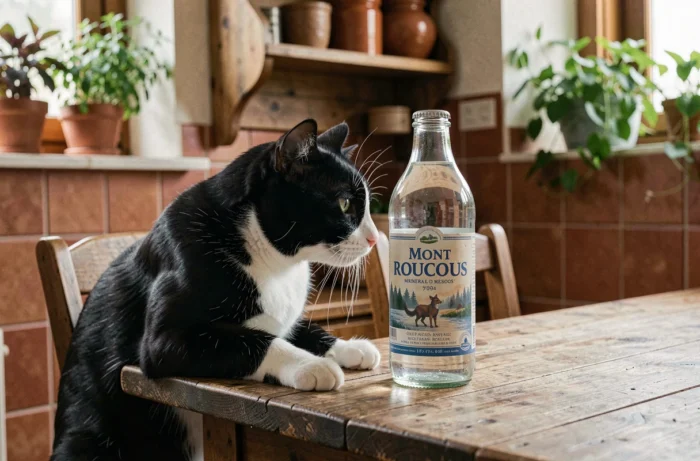
Reading a cat water label: thresholds to remember
Not all low-mineral waters are created equal. The label “suitable for infants” that Mont Roucous carries guarantees stricter controls on microbiological and chemical contaminants, which represents an indirect advantage for immunocompromised or elderly animals.
Three practical benchmarks for evaluating water intended for a cat:
| Parameter | Recommended threshold (cat) | Mont Roucous |
|---|---|---|
| Dry residue (180 °C) | Less than 150 mg/L | 25 to 33 mg/L |
| Calcium | Less than 50 mg/L | 2.6 mg/L |
| Sodium | Less than 20 mg/L | 3 mg/L |
Mont Roucous is well below each threshold, positioning it among the safest options for a cat at renal or urinary risk. Other low-mineral spring waters may be suitable, provided these three values are checked on the label.
The choice of water remains a often overlooked link in the urinary prevention protocol for cats. Combining a very low dry residue water with an appropriate diet and an environment that encourages water intake yields the best long-term results. Mont Roucous meets this specification without compromising on composition.