
The itching in dogs drives many owners towards animal aromatherapy. Before applying even a single drop on your pet’s coat, one question deserves to be asked: which essential oils present an acceptable benefit/risk ratio, and which ones expose your dog to documented poisoning by veterinary poison control centers?
Comparative toxicity of common essential oils in dogs
Veterinary pharmacovigilance data show that not all essential oils are equal in terms of safety. Tea tree oil (Melaleuca alternifolia), often recommended for its antiseptic properties, is the one that has the highest number of reported poisonings.
A retrospective review published in the Journal of Veterinary Emergency and Critical Care (Khan et al., 2014) analyzed 443 cases of tea tree poisoning in dogs and cats. The clinical signs described range from muscle weakness and ataxia to central nervous system depression and coma, following topical application or ingestion.
| Essential Oil | Desired Use | Risk Level for Dogs | Note |
|---|---|---|---|
| Tea tree (Melaleuca alternifolia) | Antiseptic, flea repellent | High | Most frequently involved oil in veterinary poisonings |
| True lavender (Lavandula angustifolia) | Soothing, anti-inflammatory | Low (diluted) | Linalool and linalyl acetate well tolerated in appropriate dilution |
| Roman chamomile (Chamaemelum nobile) | Anti-itch, calming | Low (diluted) | Documented anti-inflammatory properties |
| Peppermint | Refreshing | Moderate to high | Rich in menthol, irritating to mucous membranes |
| Eucalyptus | Repellent, decongestant | Moderate to high | Eucalyptol potentially neurotoxic at uncontrolled doses |
This table is based on alerts relayed by CAPAE-Ouest and Anses. In practice, the tolerance profile also depends on the concentration used, the dog’s weight, and the route of administration.
To delve deeper into essential oils for dog itching, dilution and the choice of carrier vegetable oil remain the two parameters that separate a useful treatment from a toxic risk.
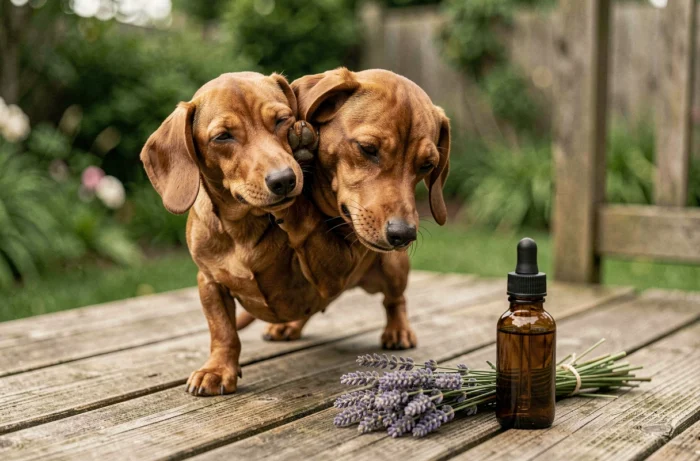
Dilution and application route: the differences that change everything
Anses and veterinary poison control centers point to a common factor in the majority of accidents: the application of pure essential oil directly on the dog’s skin. Canine skin, thinner than human skin in certain areas (belly, ears, groin), absorbs volatile compounds more quickly.
Dilution in a carrier vegetable oil
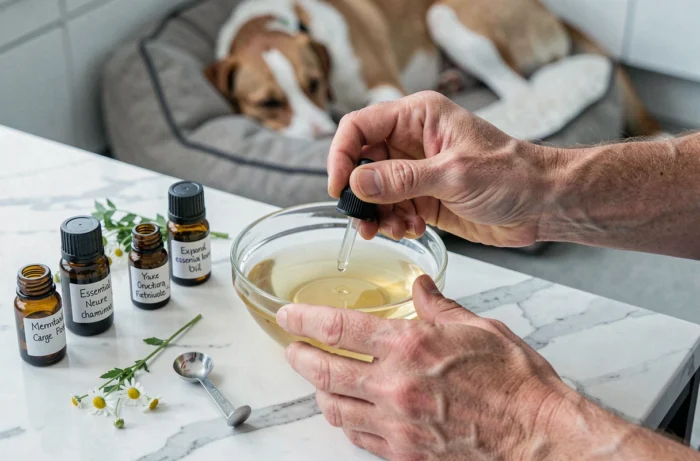
The basic rule in veterinary aromatherapy is to dilute the essential oil in a carrier vegetable oil (fractionated coconut, sweet almond, jojoba). Veterinary practice guides recommend concentrations significantly lower than those used in adult humans.
- True lavender and Roman chamomile should be diluted to a very low concentration in vegetable oil before any application on an itchy area.
- The mixture should first be tested on a small area of skin (inner thigh) for 24 hours to detect any potential reaction.
- The oral route should be avoided unless explicitly prescribed by a veterinarian: the dog’s hepatic metabolism does not handle phenols and ketones like that of humans.
- Atmospheric diffusion remains the least risky route, provided the dog can leave the room freely.
Frequency and duration of use
Occasional use does not present the same risks as prolonged daily exposure. The most severe poisoning cases reported in the literature involve repeated applications over several days, often with undiluted products or homemade flea mixtures concentrated in tea tree oil.
The dog’s licking reflex amplifies the problem. Any treated area accessible to the tongue exposes the animal to unintentional ingestion. A light bandage or a collar during the absorption phase reduces this risk.
Essential oils and dog itching: limits in the face of underlying causes
The anti-inflammatory properties of true lavender or Roman chamomile may temporarily alleviate itching. However, an essential oil does not treat the cause of chronic itching.
The origins of scratching in dogs fall into several distinct categories: parasitic (fleas, mites), allergic (atopy, food allergy), infectious (bacterial pyoderma, fungal dermatitis), or metabolic. An essential oil applied to a deep pyoderma, for example, does not replace targeted antibiotic treatment.
When animal aromatherapy has its place
Veterinary aromatherapy finds its usefulness as a complement, on two specific fronts:
- Soothing a mild and occasional skin irritation (insect bite, small area of scratching without superinfection) with diluted true lavender.
- Reducing anxiety related to itching through atmospheric diffusion of lavender, which can decrease the vicious cycle of scratching-stress-scratching.
Beyond these situations, a veterinary examination remains the first logical step. Veterinary poison control centers have reported an increase in calls related to essential oils over the past few years, reflecting a growing but not always controlled use of these products.
Specific precautions based on the dog’s size and breed
The weight of the animal directly alters the safety margin. A small dog (under 10 kg) presents a higher risk of poisoning than a large breed dog at the same dose, simply due to the concentration effect.
Some breeds with sensitive skin (French bulldog, shar-pei, west highland white terrier) more frequently develop skin reactions. In these dogs, prior testing on a small area is non-negotiable, even with an oil known to be well tolerated.
Pregnant or nursing females and puppies under three months old are formal contraindications to any topical application of essential oil, as emphasized by the safety sheets relayed by Anses.
Animal aromatherapy offers a range of measurable complementary care, provided that dilutions are respected, oils with documented toxic profiles are avoided, and a drop of lavender is not substituted for a veterinary diagnosis. Pharmacovigilance data are clear: the safety depends less on the chosen oil than on how it is used.